






Best Golf Simulator 2026 - Our 6 Favorite Golf Simulators, Tested And Reviewed
If you want to find a way to practice your golf game at home then we've listed the best golf simulators currently available right now


The advent of the golf simulator has dramatically changed how many golfers practice. By analyzing each shot via camera, radar and sensor you’re armed with data-driven feedback that highlights your strengths, but more importantly, your weaknesses. But the best golf simulators don’t just allow you to practice with purpose, they also enable you to play some of the world’s best golf courses - virtually of course.
While golf simulators used to be the preserve of the touring pro and their coaches due to the expense, the tech has now trickled down to create a number of more affordable models designed for amateurs wishing to emulate the perfect indoor setup on a budget; arm yourself with a budget launch monitor and one of the best golf nets and away you go.
I’ve tested plenty of models, from costly simulators favored by professionals to entry-level offerings, and have selected my preferred devices here, with a view to help you find the best golf simulator for both your game and your budget.
Best Golf Simulator 2026
The Quick List

Living up to its pre-launch buzz, the Garmin Approach R50 blends top-tier data accuracy with exceptional simulator performance. Setup is quick and the data displays are impressive, but the immersive virtual course play is the true headline feature.

Few simulators rival the realism of Full Swing, which projects shots onto the screen instantly with zero lag. When a system carries the stamp of approval from Tiger Woods, you know it is more than good enough for you, too.

The Square Golf Omni offer a portable option for those who want to use their tech both indoors and outdoors. The instant feedback, accurate data and affordable price make it an excellent budget-friendly option.

If you’re looking to build a simulator setup on a budget, the SkyTrak+ is a great option. An improved processor and hitting zone make it more user-friendly than ever, providing an experience that makes high-end home practice accessible to everyone.

Trackman essentially defined the modern simulator market and its reputation for precision and accuracy is why it remains the undisputed gold standard - you only need to look at a PGA Tour driving range to see its dominance.

Foresight’s photometric technology operates at a staggering speed, capturing thousands of images per second to analyze ball flight and club delivery with top-tier precision. Perfect for those who are very serious about their practice sessions.
Our favorite

The R50 gets the nod as the top pick in this guide thanks to its party trick of being both launch monitor and simulator in one.
It’s one of the larger units in this guide but this means that you benefit from a 10” full color touchscreen; I was impressed with just how functional this was, both clear and responsive. Garmin has equipped the R50 with three cameras, which combined track 15 club and data points as well as the ball’s flight.
During my testing it compared favorably to rival machines, delivering accurate, customizable data. I enjoyed being able to view all the numbers together as well as seeing them as graphical representation of impact between club and ball, while the impact playback delivers a slo-mo video that’s helpful when ascertaining the quality of strike relating to any new move you might be working on. To get this club data you do need to add a sticker to the clubface but fortunately 250 are provided.
The Play feature is a real highlight. With more than 43,000 courses, you’re spoilt for choice, with stunning graphics , a flyover of each hole before you tee off and an impressive degree of realism. It does require an annual subscription, however. It’s a minor niggle, alongside having to crouch down to adjust the data settings, but neither greatly detract from just how good the R50 is as both monitor and simulator.
- Read our full Garmin Approach R50 review
Used by Tiger Woods
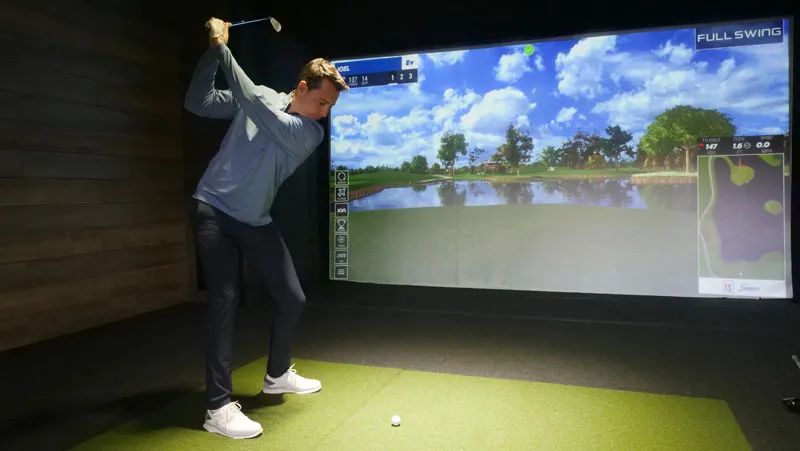

Joel Tadman testing the Full Swing Golf Simulator
An endorsement from Tiger Woods won’t have hurt Full Swing’s simulator credentials but it’s the wide range of features and fantastic playing experience that are the real selling point here.
The simulator makes a strong first impression. The Pro series option comes with a solid wood enclosure, a cinema quality projector, an energy absorbing diffuser screen, and a high-quality carpet to hit from. Together, they create an indoor set up that’s as good as it gets.
Equipped with an ION3 camera that captures high-speed, overhead video of the clubhead at impact, you can quickly and clearly assess the quality of your strike. This combines with a line-tracking sensor that enables your ball flight to be mirrored on the screen; the accuracy here is superb with realistic ball flight graphics to match.
As mentioned, the playing experience is equally impressive. You get 84 courses to choose from, meaning you can tackle the likes of the iconic 17th green at TPC Sawgrass from the comfort of your own home. And taking away home comforts, the screen can also be used to view movies, adding to the impressive functionality of this highly capable simulator.
- Read our full Full Swing Golf Simulator Review
Best value

The Omni brings the golf simulator experience to a wider audience thanks to its relatively low cost. But despite the price tag it still delivers, supplying comparable data to models that cost far more. An asterisk is required here, however. During my testing, while the data compared favorably when using the Omni indoors, taking it outside presented a few issues. Seemingly direct sunlight messes with the quad-camera infrared tracking system, which led to some pretty serious discrepancies when it came to distance numbers; my long irons were sometimes out by as much as 20 yards.
Still, there’s plenty to like here, especially for the golfer who’s planning to use the device exclusively indoors. The range of metrics captured are impressive, including core numbers such as ball speed, spin rate, attack and launch angle and carry. All that’s required to track club data is to add the reflective stickers to the club face and shaft. There’s no subscription fees either, with access to the Square Golf app available via 1000 free credits; the app is where you’ll find the virtual courses (Game Mode), as well as the two main modes - Driving range and Data Mode - and the Putting Practice setup. Integration is also available with third-party apps like GSPro, E6 Connect, and Awesome Golf, which are a little more advanced and user-friendly.
I do have a few minor gripes. The screen requires you to kneel down to read the data, and doing this after each and every swing becomes something of a chore. There’s also no carry case provided. Still, as an affordable option the Omni ticks most of the boxes.
- Read our full Square Golf Omni Launch Monitor Review
Best course choice

SkyTrak+ Launch Monitor sitting on grass
For many golfers, the appeal of a home simulator is the access it provides to a library of virtual courses. And this is SkyTrak+’s raison d'etre. With around 100,000 courses on offer (once you sync with the companion app), including Californian gems such as Torrey Pines and Pebble Beach, it’s class-leading. No surprise it’s my pick as the best course choice in this guide.
But the SkyTrak+ is more than just a mighty impressive simulator. For data driven golfers looking to improve their game, it captures a full suite of numbers, including ball speed, launch, path and face angle, and carry. During my testing it delivers these with an accuracy that’s compatible with other rival monitors. Factor in the intuitive app interface and you have a simulator that’s ideally suited for the home user.
Downsides? The app does require an annual subscription and like the Square Golf Omni, there’s no carry case provided.
- Read our full SkyTrak+ Launch Monitor Review
A Tour favorite

Man testing the Trackman simulator
Trackman has become synonymous with the best golf simulators and the best launch monitors. The orange square is a familiar sight at driving ranges across the professional tours. It has its drawbacks, namely the high cost, but when it comes to the sheer level of data and features on offer, it’s hard to beat.
So why do many of the game’s best players and coaches lean on Trackman? For starters, the dual Doppler radar technology makes for unparalleled accuracy. Tracking the ball for up to six seconds of its flight means that it’s relying less on an estimated trajectory and more on the actual ball flight, so the curve of the ball as well as the resulting numbers are exact. The feedback is instant, with the TrackMan Performance Studio software a doddle to use.
The features list is a long one but the standouts include more than 160 pre-installed courses, skills challenges, putting analysis, advanced club-fitting tools and swing video integration. It’s as comprehensive as you’d hope given the five-digit price tag, which grows steeper when you factor in the extras required for a home simulator set up.
- Read our full Trackman Simulator Review
Best premium sim
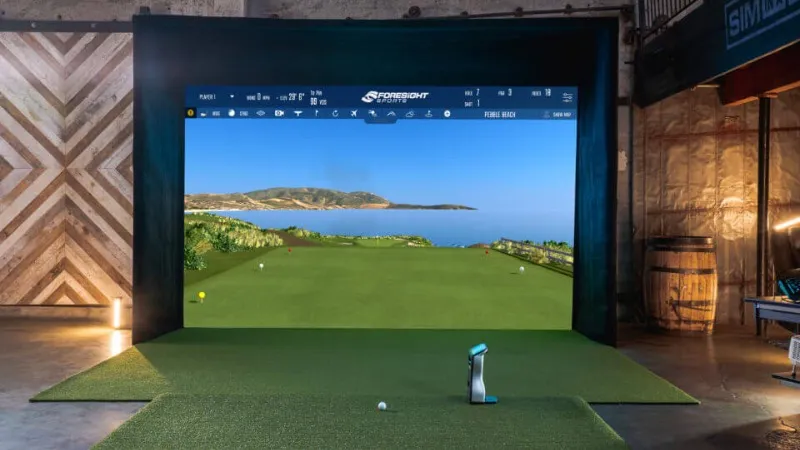
A Foresight Sports Simulator setup for play
The GCQuad is another model that’s used by tour pros, and like Trackman, has a price tag to match its impressive credentials. If you already own a Foresight monitor you can opt for the more affordable Sim-In-A-Box or Net-Ready packages to create your home simulator set up, but it’s the premium package that we’re looking at here.
The premium package features a monitor of your choice - beyond the GCQuad there are the Hawk, GC3, GC2 or GC2 HMT models - alongside a high-performance laptop. From here you have access to a wide range of metrics, from the ‘basics’ such as ball and club speed, carry and distance, to more advanced numbers that allow you to really dig into the details, including path, lie angle, angle of attack, strike location and more. During my testing I found that all were delivered with the degrees of accuracy you’d expect from a monitor high in profile and price.
While you do require quite a lot of room to make the most of all its features, from the virtual courses to the playing drills, I was left impressed with just how well the interface works, making all the data easy to read and interpret resulting in a user experience that’s really top-notch.
Specifications table
Model |
Data |
Portable |
Courses |
Garmin Approach R50 |
Club and ball |
Yes |
43,000 |
Full Swing Golf Simulator |
Club and ball |
No |
80+ |
Square Golf Omni Launch Monitor |
Club and ball |
Yes |
22 |
SkyTrak+ Launch Monitor |
Club and ball |
Yes |
100,000 virtual |
Trackman Simulator |
Club and ball |
Yes |
145 |
Foresight Sports Simulator |
Club and ball |
Dependent on model |
20+ |
How we test golf simulators

Joe has worked in the golf industry for nearly 20 years in a variety of roles, including Head PGA Professional at Ryder Cup venue The Celtic Manor Resort and heading up the National Fitting Centers for both Titleist and TaylorMade. Joe is in charge of Golf Monthly's driver, iron and tech reviews, including golf launch monitors and simulators.
We test golf simulators by putting every club in the bag to work and thoroughly evaluating setup speed, software usability, and overall portability. Backed by years of comparative data, our recommendations are always built on real-world, hands-on experience rather than a spec sheet. This unbiased approach applies to everything we review at Golf Monthly, where coverage can never be bought. To read more about how we test our equipment, take a look at our testing methodology here.

We spend multiple hours both directly and indirectly testing simulators - directly for our reviews of each product and then indirectly for when we our testing golf clubs like the best golf drivers to analyze the data we gather during our testing procedures like ball dispersion, club head and ball speeds. These simulators also help us compare and contrast the performance of a club against another.
How to choose a golf simulator
Indoor/Outdoor Use
Are you looking for a tool that follows you to the range, or a sanctuary where you can play a virtual 18 holes at one of the most famous golf courses in the world on a week night? For the golfer on the move, a portable launch monitor paired with a sturdy practice net offers the ultimate flexibility for both indoor and outdoor sessions. But for those ready to commit to a serious home studio, a full simulator bundle, complete with a projector and impact screen, is the only way to achieve a true immersive experience While the net-and-monitor combo is more practical and budget-friendly, the full simulator setup provides the kind of visual realism that keeps you engaged.
Accuracy
Practice data is only as good as its reliability. While standard launch monitors perform exceptionally well under controlled conditions, top-tier models go a step further by accounting for real-world variables like elevation and air density. This means how far you hit a 7 iron on the golf course is directly translated to your launch monitor. Though greater accuracy comes at a higher price tag, it eliminates the guesswork from your club selection in a way entry-level monitors can't match.
Metrics
Basic ball-flight data has become a standard feature, but club-head delivery data remains a premium upgrade. To see the specific metrics that dictate your shot shape, you’ll need to invest in a device with more sophisticated camera or radar arrays. Whether it’s the Garmin R50 or the Foresight GC3, spending a bit more is often the only way to get the full picture of your swing.
Features
While basic models excel at providing the essential data needed for practice, premium systems allow for an immersive transition into course simulation. If you want the ability to play 18 (virtual) holes at Augusta, it’s worth investing in a top-tier system.
Price
Like much in life, with golf simulators and launch monitors you tend to get what you pay for. The most expensive models featured in this guide are beyond the budget of most but they do offer an impressive experience. But that’s not to say you can’t benefit greatly from the less expensive models, which still deliver plenty of data and can easily be paired with one of the best golf mats and best golf putting mats for use at home.
FAQs
Is a golf simulator worth it?
Although a golf simulator requires a notable upfront investment, its payoff as a training tool is hard to exaggerate. It can turn your home into a practice hub, delivering invaluable, tour-level feedback top players rely on to stay sharp. Driven by growing market competition, simulator tech has become dramatically more accessible in recent years, with brands delivering high-performing software into far more affordable units.
What is the difference between a simulator and golf net?
While a standard practice net is great for working on your swing path and tempo, it provides no statistical feedback on actual ball flight. A simulator gives you that by measuring and delivering precise data for every strike.
How much does it cost to get a golf simulator?
Cost is entirely dependent on the scale of your setup and what you want it to look like. If you want the full experience, a premium Full Swing or Trackman setup is a luxury investment that often carries a hefty price tag. However, if you're primarily looking for accurate feedback and fun virtual rounds, the market offers great value at the lower end, for you can now build a functional home bay unit for less than $1,000.
What size room do I need for a golf simulator?
To ensure a safe setup, aim for minimum room dimensions of 12 ft long, 10 ft wide, and 8.5 ft high. If you find yourself holding back with your driver out of fear of hitting the drywall, the space simply isn't big enough.
What is the most realistic golf simulator software?
TrackMan may set the benchmark with the market’s most realistic simulator software, but its $20,000+ price point keeps it out of reach for most. Fortunately, options like the Garmin Approach R50 and Full Swing have closed that gap, bringing high-fidelity graphics and tour-level data accuracy to everyday golfers at a much more accessible price.
What simulator does Rory McIlroy use?
Back-to-back Masters champion Rory McIlroy relies on a dual-technology approach when it comes to his launch monitor/simulator setup, combining the strengths of TrackMan with the Foresight GCQuad. McIlroy and Tiger Woods have made significant investments in the golf tech sector as key investors in Full Swing, the company powering their simulator-based indoor league, TGL.
Which golf simulator has the best putting?
The ExPutt RG Real-Time Golf Putting Simulator has already pulled comfortably ahead of the competition in the putting space thanks to its detailed stroke analysis and focused training features, it stands as the top of the pops for indoor putting simulation.
Finally be sure to take a look at some of our other golf gear guides too, such as the best golf GPS, best golf watches, or the best golf rangefinders.