






Best Budget Golf Rangefinders 2026
In this guide we look at the best budget golf rangefinders on the market that show you don't have to break the bank to get a quality device


Having a reliable rangefinder can help you hit shots with more conviction as you know your exact distance to the target. They will also improve your course management as you can use them to zap hazards to see if they are within range or if you can let rip safe in the knowledge that you can't reach them.
Cost is a factor and not everyone can afford the best golf rangefinders like the Bushnell Tour V7 Shift or the Garmin Approach Z30. The good news is that the budget rangefinder market has only got bigger and better in the last few years as brands battle to provide the best value device for more casual players, or simply for those who want to save a bit of cash and potentially reinvest it in another part of their game.
In this guide, we break down our picks for the best budget golf rangefinders currently on the market. If you're still unsure what you want, we have plenty more rangefinder guides for you to dig your teeth into like the best golf rangefinders with slope and best bushnell rangefinders. If you want a different piece of tech, we recommend having a look at both our best golf gadgets and best golf watches guides for even more choice.
The Quick List

The Captain Air is the more budget-friendly of the two impressive Blue Tees lasers released in 2026. It looks and feels premium whilst delivering features we'd expect on devices double the price.

While the GolfBuddy 2S Pro is compact, don't let the size fool you - this is a standout choice for any golfer looking for premium performance without the premium investment.

The Inesis Golf 900 is tailored for those who prioritize fast, dependable yardages over complex bells and whistles that rarely see use. It is the perfect 'pick up and shoot' laser for those who want to get to their ball, find out their yardage and swing away with little fuss.

Despite its modest appearance and compact size, the VPro GS03 is another small laser that packs a punch. We found the display to be crisp and clean, whilst the device itself has features typically found in lasers that cost double or even triple the price.

Another simple but reliable laser is the Pro L2 from Shot Scope. Its another compact, 'pick-up-and-go' device that delivers essential features like slope-adjusted distances and target-lock vibration in a featherlight package.

Who says high-performance tech has to be boring? The Pinned Prism+ proves you can have it both ways, pairing excellent rangefinder functionality with a diverse choice of colors. It’s the perfect choice for the golfer who wants a device that works as well as it looks.
Best Budget Golf Rangefinders
Top pick

The Blue Tees Captain Air proves that you don't need to empty your wallet to get a premium-feeling, feature-rich rangefinder. It comes in right at the limit of what we consider a 'budget' device at $250, but it boasts excellent build quality, an IP65 dust and water resistance rating, and a high-quality carry case. Even as a standard "pick up and shoot" laser, it performs reliably with a solid 6x magnification LCD display and crisp red/black detailing that delivers fast, accurate yardages.
The smaller brother of two impressive 2026 laser releases from Blue Tees, headlined by the Captain Pro, the Captain Air sets itself apart from rivals around this price point through its "smart" features and connectivity when paired with the Blue Tees app. Even at its accessible price, it offers front and back green GPS yardages. Furthermore, for a modest subscription fee, golfers can unlock "True Distance Adjusted Yardages" which factor in slope, wind, elevation, and temperature.
At full price, it is only $50 less expensive than the Captain Pro, buyers should weigh up whether they want to spend a little extra for the more well-rounded device of the two, but the Captain Air was an easy choice for our top pick in this budget-friendly guide.
- Read our full Blue Tees Captain Air Rangefinder Review
Most compact

A deserving entrant in our Editor's Choice List of 2025, it was a no-brainer to select the Laser 2S Pro as our pick for the best compact laser in our budget rangefinders guide. It has a nice weight to it, not too heavy and not too light, whilst the simplistic color design will suit those who just want a simple laser that works.
Of particular note is the technology featured in this laser, specifically the different modes you can use it in. Standard mode gives straight-line distance, Pin Finder mode locks onto the pin with a quick vibration to confirm this, and finally, Scan mode allows you to continuously scan for five seconds to assess the lay of the land in front of you. Additionally you can toggle slope on and off in all three modes. The final mode to mention is Buddy mode which is the lasers triangulation technology similar to that of the Voice Caddie model above. As such you can get an accurate yardage without being stood near your ball.
Ultimately, the GolfBuddy Laser 2S Pro is difficult to fault when you weigh its high-tier performance against its accessible price point. While the display lacks the razor-sharp resolution found in top-end devices, it remains highly functional for everyday play.
- Read our full GolfBuddy Laser 2S Pro Rangefinder Review
Easiest to use
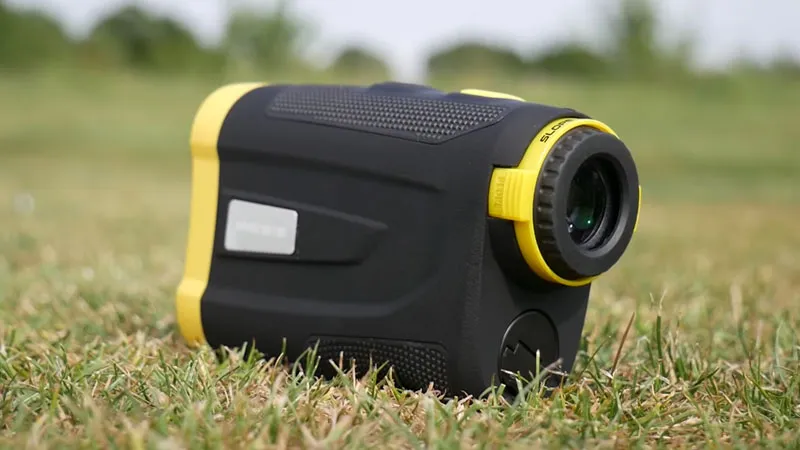
If you’re looking for high-end performance on a budget, the Inesis Golf 900 is hard to beat. The optics are surprisingly sharp, and the unit comes with a sturdy case that feels built to last, something we rate highly when it comes to budget-friendly devices simply because so many brands seem to cut corners when it comes to the case in an attempt to save on production costs and increase profit margins.
With 6x magnification and yardage accuracy within +/- 1 yard, changable between yards and meters, the device delivers a pro-level experience. Despite its entry-level price point, the 900 looks and feels like a premium laser to equip yourself with. It does not have all the bells and whistles of some of the best Bushnell rangefinders, but it's dead easy to use, fantastic value for money and does have some cool features such as slope functionality and a switch that allows you to turn it off for tournament play.
- Read our full Inesis Golf 900 Laser Rangefinder Review
Cheapest with slope

The market for budget rangefinders expands every year and the quality of these entry-level devices continues to impress, with it now entirely possible to find a slope-enabled laser for under $100 - the GoGoGo Sport VPro GS03 stands out as the premier budget choice in this category.
While a non-slope version is available at an even lower price point for those who prioritize simplicity, we believe the added versatility and 'plays-like' yardages of the GS03 make it well worth the modest additional investment.
There's a lot to like here other than the price - our first impression was that the soft, velvety finish of the GS03 feels great in the hands and coupled with some strategically placed raised grip contouring, it is a very comfortable hold. Once held up to our eye we were greeted with a beautifully crisp display, so we immediately went to try out the slope mode which is available via a small flick of a switch on the side of the GS03 and this is very easy to read. We compared the readings with one of the best bushnell rangefinders and they were basically the same identical to within 0.2 of a yard which was extremely encouraging. This is a brilliantly well-rounded device that is one of, if not the best budget golf rangefinder with slope.
- Read our full GoGoGo Sport VPro GS03 Laser Rangefinder Review
Best lightweight

If you just want a rangefinder that works from the moment you take it out of the box, the PRO L2 is an ideal choice. It’s brilliantly simple, lightweight and priced significantly lower than the big-name alternatives. You won't find the bells and whistles of a $500 unit here but you will get fast, accurate distances every single time. It’s the perfect 'grab and shoot' laser for the golfer who wants to spend less time fiddling with settings and more time focusing on their next shot.
The first thing we noticed in our testing is that it is the weight, or lack of - this means it perhaps doesn't feel as premium as other models, but given the price that's to be expected. A word of warning though, if you have shaky hands then lightweight lasers will not get the job done for you and you'll need something sturdier. The L2 locks onto targets very quickly, it has 6x magnification and the slope functionality is very simple to turn on or off. In terms of accuracy, we found the L2 to be competitive with many more expensive models.
It only measures up to 700 yards but even that is way more than you will need. We enjoyed the built-in magnet as well, which made it easy to attach to a trolley or buggy and overall we see this being a very popular model because of the combination of performance and price.
- Read our full Shot Scope Pro L2 Rangefinder Review
Best color choice

The Pinned Prism+ Rangefinder is that one person in your friend group that always seems to be ahead of the fashion trends. Oh, baggy cargo pants are in again? Well, he's been wearing them for 6 months already.
Everything about this device feels modern and, frankly, pretty cool. If it were a person it would be a cool 20-something year old who is really good at surfing (and let's you know about it).
Enough of the rambling then, we do we love this device so much? Well, I've given it the label of best color choice, so we'll start with the looks - they really set it apart from anything else on the market. I chose it in my favourite green colourway, but there are six other colours to choose from, including red, navy, black, pink and white. Even the ‘Pinned’ font has a charm to it that no other rangefinder I’ve tested can boast. It also feels very premium once it is in your hand and that level of quality carries over to the case supplied which is one of the best I've ever used.
My enjoyment of the Prism+ didn’t stop at how it’s designed; the performance stacks up, too. The highlight is, without a doubt, the 4K OLED display. It’s unbelievably clear and uses red graphics that really pop out in all light conditions. The 7x magnification is as much as you can get on the market, too. Having the slope functionality is also brilliant, but the lack of a scan functionality is a little disappointing - albeit that's the only real criticism of this laser, which we deservedly awarded 5 stars out of 5.
- Read our full Pinned Prism+ Rangefinder Review
Specifications table
Model |
Range |
Magnification |
Slope functionality |
Battery |
Blue Tees Captain Pro Rangefinder |
1000 yards |
6x |
Yes |
Rechargable USB-C |
GolfBuddy 2S Pro Rangefinder |
1093 yards |
6x |
Yes |
5,000+ actuations |
Inesis Golf 900 Laser Rangefinder |
1,300 yards |
6x |
Yes |
5000 actuations |
GoGoGo Sport VPro GS03 Laser Rangefinder |
1000 yards (250 flag) |
6x |
Yes |
40-50 rounds |
Shot Scope Pro L2 Rangefinder |
700 yards |
6x |
Yes |
Approx 5,800 measures |
Pinned Prism+ Rangefinder |
1000 yards |
7x |
Yes |
70 rounds |
How we test for the best budget golf rangefinders

Conor joined Golf Monthly in late 2024 after graduating with a Masters degree in Sports Journalism from St Mary's University and heads up reviews for rangefinders, GPS and golf watches.
Conor is lucky to have Royal County Down as his home golf course, beginning to play the game at the age of four, later becoming a caddy at R.C.D at just eleven years old and doing so for over 12 years. Playing to a 5 handicap, you’ll likely find him on the range trying (and failing) to hit a Shane Lowry-esque stinger that helped him win The Open Championship at Royal Portrush.
At Golf Monthly we take product testing very seriously and we have a comprehensive testing procedure when it comes to all laser rangefinders. This involves using the different models out on the course over a number of rounds and in different conditions. Through this extensive testing we are able to get an accurate feel for how each specific model deals with variables such as sunlight, rain, and wind etc.

Dan Parker testing the Pinned Prism+ Rangefinder
Our review team is made up of avid, passionate golfers who have used all bits of golf tech throughout the years - from the best golf GPS devices to best golf simulators and launch monitors. This helps us build an extensive base of knowledge to help review each product, often comparing them against older models or products in which they will be competing directly against. Led by Conor Keenan, a former caddy at one of the best golf courses in the world, Conor is assisted in testing and reviewing rangefinders by other able members of the Golf Monthly team who know a thing or to about what makes a good laser! We look out for a range of factors to judge each rangefinder on, including accuracy, display, waterproofing and durability before informing our readers with sound, bias-free buying advice.
We pride ourself on our impartial reviews, built upon a tried and tested reviews structure. No brand gets preferential treatment, nor can a manufacturer 'buy' a good review - we simply call it how we see based on our experience and expertise in each field.

Conor Keenan testing the CIGMAN CT-1200PRO Rangefinder
How to choose the best budget golf rangefinder
Accuracy
Inaccurate distance readings can quickly ruin a good round of golf. Consistent accuracy is what separates elite rangefinders from unreliable alternatives, and many lesser-known online brands often fail to deliver on that promise. Sticking to the tested manufacturers featured above ensures you receive dependable numbers every time, keeping you from flying your approach shots over the back of the green.
Slope
For players unfamiliar with the rangefinder tech, slope measures direct line-of-sight distance and adjusts it based on elevation changes, so an uphill 150-yard shot might actually play like 160 yards, prompting you to club up. While having elevation-adjusted numbers is a helpful feature to have during casual rounds, remember that using slope technology is illegal during official tournament play.
Convenience
To keep the pace of play moving, you'll need a laser that slips effortlessly from its case and delivers instant yardages the moment you target the pin. Although the vast majority of devices today are remarkably fast and user-friendly, certain models remain far easier to operate than others.
Strength
If you're anything like me, you might be a little clumsy and drop your laser from time to time, then its best to get a durable device that won't fall to pieces the moment it hits the ground. It is worth double checking the durability and impact resistance of your budget rangefinder to check it won't break after a few months of use and need replacing. You should also inspect the included carry case, a detail where manufacturers often cut corners and save money when making a budget-friendly device.
Waterproofing
Weather is inherently unpredictable, making water resistance an essential feature for any rangefinder - depending where you are playing of course. Choosing a weather-resistant model lets you stay focused on hitting your distances rather than shielding your laser from the rain, giving you complete peace of mind the moment less than ideal weather rolls in.
FAQs
Are cheap rangefinders worth it?
Finding a reliable, high-performing rangefinder doesn't require spending a fortune, but buyers must navigate the budget market carefully. While many cheap knock-offs suffer from inaccurate yardages and poor weatherproofing, devices do exist that deliver performance far beyond their price tags - and have been included in this guide!
What is a good inexpensive rangefinder?
There are several really good rangefinders that come with relatively cheap prices at the moment, including the Inesis Golf 900, GolfBuddy Laser Lite 2, Blue Tees Series 3 and other models from Inesis, Voice Caddie and even Pinned.
If you want more golf tech buying advice, check out our guides on the best golf launch monitors, best cheap launch monitors, or the best value golf watches.