






Best Golf Blade Irons 2026
We run through the best muscleback irons on the market for those seeking the ultimate in feel and workability


A set of blades in the bag signifies a true player. Stripped back of any unnecessary bells and whistles, they are a tool for the flusher, allowing for a level of workability and shot making that you simply don’t find elsewhere. After all, there’s a reason that the best blades are used by many of the world’s top players, and why they are coveted by many low handicappers, too.
Being able to shape the ball, to flight it down is just one of the attributes that all the best blades offer. They also offer an unprecedented level of feel, thanks to the forging and choice of metals, as well as an aesthetic that is cool, clean and understated.
If your game isn’t yet ready for a set of the best blades, then never fear. We have extensive guides to the best golf irons, best compact mid-handicap irons and best irons for distance, which will help you to find the right irons for your game, whatever stage of development you’re at.
But for now, we’re focused on blades, and we’ve tested a wide range of models, selecting our favorites here across a number of categories.
The Quick List

A triumph of engineering and aesthetics, they offer one of the purest visuals and impact sensations I have ever experienced in testing, with a surprising amount of playability for a muscleback

Arguably the best looking irons on the market, the 620 MB irons are commonly seen in the bags of players plying their trade on the PGA Tour, and for good reason.

One for the purists - an iron that requires a serious ball striker to get the most of them because of the compact blade length and minuscule top line but delivers incredible workability and feel.

About as classic as an iron can get, the Staff Model blades can compete the best in the category, especially in dispersion. The feel on well-struck shots is exceptional.

Ping has delivered a quite stunning aesthetic here, these clubheads are as clean and crisp as any we've seen and the new shaping frames the ball beautifully at address. Performance is as strong as the looks.

The Takomo 301 MB is an exceptional pure forged iron offering. The incredibly clean, minimalist looks coupled with the buttery soft feel make them some of the best irons of their type that I have tested.
Load the next 2 products

A beautiful, retro-style blade that had me drooling when I unboxed them. It's not just the looks I was impressed with - features like the progressive CG controls flight well, while the V sole makes turf interaction as smooth as anything.

The Vice Golf VGI03 is a legitimately good blade iron, offering low-handicappers a premium, one-piece 1020 carbon steel build. The matte finish and compact profile look sharp at address, whilst the price tag is more than reasonable.
Best Golf Blade Irons
Top pick

The 3DP MBs can make a strong claim to be the best looking iron, never made blade, currently available. Cobra has managed to make them look clean and sophisticated without appearing retro; the subtle highlighting of the complex internal lattice structure that lies beneath that beautifully brushed surface tells you that this isn’t your father’s set of blades, but one made for the modern ball striker.
The astounding appearance continues at address, with every iron perfect in its shape and profile. Here, the amount of offset, the thin top line and the blade length are all faultless, and kudos to Cobra for getting it just right.
One of the reasons you buy a set of blades is for the feel they deliver. And here it’s as good as it gets. Like the 3DP X irons, the MB is proof that 3D-printed golf clubs can provide the same buttery soft feel as traditionally forged models. It results in excellent feedback without being overly punishing; this is largely due to the aforementioned 3D-printed internal lattice core that dampens vibrations and creates a pure sensation at impact that I loved.
It also means a degree of forgiveness that’s often missing in a blade; Cobra has used that lattice structure to redistribute weight in the heel and toe, and this perimeter weighting is noticeable. It makes the 3DP MB far more accessible as a result.
Out on the course, distance control was precise, with the irons delivering the degree of workability you’d hope for in a blade. The sole is another highlight, resulting in sublime turf interaction.
Perhaps the only negative then is the price. The 3DP MB’s are eye-wateringly expensive and likely out of the range of most golfers.
- Read our full Cobra 3DP MB Irons Review
Best Tour model
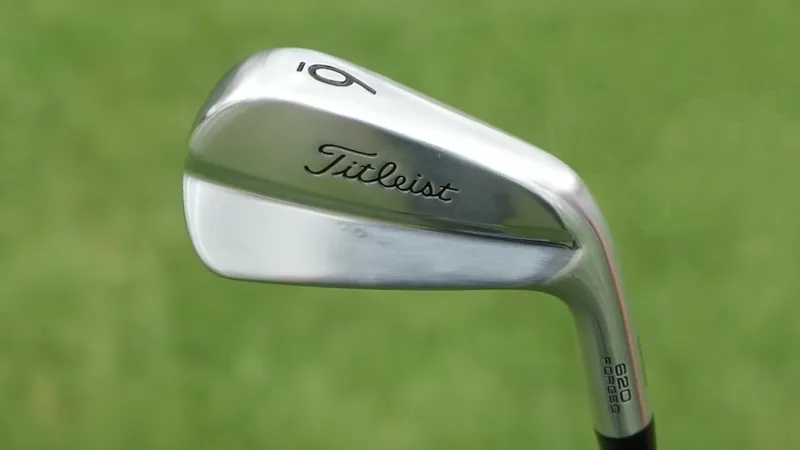
The 620 MB from Titleist is a true players’ iron. The one-piece forged design delivers the classic good looks that are a large part of a blade’s appeal. But it’s also responsible for the workability that make these irons so popular among Titleist’s touring pros. The CG is positioned to enable players to shape the ball as they wish, allowing them to shape it both ways with ease as well as flight it up or down. Out on the course, I was able to produce a consistent and penetrating ball flight.
The muscleback design also contributes to the sublime feel. The feeling off the face is as smooth as you could wish for, with accompanying acoustics and the level of feedback that you're hoping for from a classy blade such as this.
Naturally, the shorter blade length and slim topline and sole that will look so appealing to better players at address, make for a less forgiving club, emphasizing that the 620 MB are best left to those with the requisite ball striking capabilities.
- Read our full Titleist 620 MB Irons Review
Best feel

The Pro S-1 blades, with the new satin finish, are as good looking a club as you could wish for, and give the new Cobra blades featured in this guide a run for their money when it comes to appearance. The finish also has a practical aspect, helping to reduce glare.
The shape is pretty traditional, with beautifully shaping throughout the set. For the better players the blade length, thin topline and sole and minimal offset will all appeal, delivering confidence that they’ll be able to move the ball as they wish. Certainly, out on the course I could work the ball both ways at will, while the high spin rate and consistent carry numbers point to a beautifully constructed set of irons that will respond reliably to well-struck shots.
Mizuno are known for producing some of the best feeling clubs around, and it’s the case here. Using its Grain Flow Forged HD process, with the inclusion of a copper underlay alongside the mild carbon steel, it’s created an impact feel that’s stunning; smooth, pure and satisfying , aided by sole design that produces great turf interaction.
- Read our full Mizuno Pro S-1 Iron Review
Best shelf appeal

If you’re drawn to blades because of how they appear then the Wilson Staff Model won’t disappoint. Blending the classic good looks of a traditional blade with a few subtle nods to modernity, it’s a club that whispers, not shouts and results in shelf appeal that’s second to none.
But looking like George Clooney isn’t much good if you then fluff your lines. Fortunately, the Staff Model Blades come well-rehearsed, resulting in a buttery soft feel at impact, with a suitably muted acoustic to match. Add in that slim sole that cuts easily through the turf, and you get an iron that, for the better player, is a joy to use.
From a performance perspective, the inclusion of Wilson’s Precision Toe Weighting, which adds mass in the toe to slow down face rotation and minimise left misses, works; I only managed to leak three balls left of target throughout my testing period. It’s a nice addition to an overall impressive package that makes the Wilson Staff blades among the best out there.
- Read our full Wilson Staff Model Blade Iron Review
Best for technology

Blades aren’t always associated with tech. And while it’s not necessary for them to pack in all the helpful features that are required in distance and game improvement irons, they still need to function well, albeit for the requirements of the skilled player.
The Blueprint T irons from Ping are a great example of this. While it’s a pure forged blade a tungsten toe screw has been added to give them a little MOI boost; even better players enjoy some help with stability through impact.
Elsewhere, the 8620 carbon steel blade, with its milled face and grooves, makes for a wonderfully simple and effective club. The simplicity of the design means the Ts are as elegant as they come, aided by Ping's Hydropearl 2.0 chrome finish. The simplicity of the design means that, at address, you’re getting a razor thin topline and small profile, but one that still frames the ball beautifully. If you’re a flusher, it’s likely to be love at first sight.
Off the face, the feel is soft yet deep; you can almost feel the ball remaining on the face just a fraction longer, resulting in unrivaled feedback. Combine with the aforementioned aesthetics and you’re getting one of the best Ping irons available for better ball strikers.
- Read our full Ping Blueprint T Irons Review
Best value

The Takomo 301 MB iron.
Golf is expensive, but the good news is some of the best budget irons perform just as well as sets that cost north of $1500. The Takomo 301 MB are an example of this, delivering an exceptionally soft, buttery feel at impact that rivals some of the most premium blades on the market. Crafted from precision-forged S20C steel, they offer highly responsive feedback that lets you know exactly where you struck the ball. Even on off-center hits, the sensation remains pleasant rather than harsh, retaining much of the smoothness found in the sweet spot.
Looks wise, these blades have smashed it and they back up the premium looks with matching performance. Designed with a compact, traditional blade length, they excel in shot-shaping capability, making it easy for skilled players to intentionally manipulate their ball flights. Shots launch through a predictable, optimal window, easily achieving the peak heights you would expect from a true player's iron profile.
Launch monitor data is also pleasingly consistent, with spin rates and launch angles remain remarkably steady from shot to shot, while ball speeds easily hold their own against similarly lofted models from major manufacturing brands. Ultimately, they deliver dependable, elite-level numbers that perform far higher than the price tag would suggest.
- Read our full Takomo 301 MB Irons Review
Best direct to consumer

Arguably the best looking blades in this guide and backing up these looks with supreme performance, the Forth Worth MB blades are some of the best clubs I've ever tested.
Despite their traditional look, these muscle backs pack hidden tech. Forged from 1025C carbon steel, they feature Hogan’s Ceramic Matrix Composite (CMC) core, which precisely positions the center of gravity to optimize ball flight for each club. Instead of producing a harsh feel, this construction yields a buttery soft impact. The signature V-sole, with high leading edge bounce and softer trailing edge bounce—provides incredibly smooth turf interaction, making it especially beneficial for steeper swingers and softer course conditions.
With a relatively short blade length, the Fort Worth MB irons are highly responsive, making shot-shaping effortless for better players. Because Ben Hogan utilizes a direct-to-consumer model, these premium-forged irons come with a surprisingly digestible price tag (starting around $900 for a 5-PW set).
- Read our full Ben Hogan Forth Worth MB Irons Review
Most unique

Known for their fun aesthetic in the golf ball market, Vice steps seriously into the player's iron space with the VGI03, a blade that brings a distinctly unique look to the bag.
Constructed from a one-piece 1020 carbon steel forging, the VGI03 is designed to deliver precisely what elite ball-strikers crave: pure, honest feedback. The impact sensation is soft and muffled, allowing scratch players to know exactly where the ball met the face.
Perhaps the most unique aspect of the VGI03 blades is their position in the market. Historically, the muscle-back players are highly brand-loyal and willing to pay top dollar for the big name brands like Titleist, TaylorMade and more. Vice directly challenges this by offering these blades through a direct-to-consumer model at just $999 for a 4-PW set. To further disrupt the space and ease the anxiety of buying blades from a "value brand," Vice offers a generous 60-day return policy, even on custom builds!
- Read our full Vice Golf VGI03 Irons Review
How we test golf irons
Our testing for golf irons is built upon a comprehensive process combined with the knowledge and expertise of the Golf Monthly test team. As far as the specific procedure goes, before testing, the team will usually attend product launches and meet with the manufacturer's R&D experts to understand the new technology.
We test irons both indoors and outdoors to ensure the fairest test possible. Via an indoor simulator we can test the set in a controlled environment, collecting critical metrics like spin, club head speed and launch angle. After we put each set through their paces indoors we take them out onto the course to see how they fair in different conditions. We also test across a range of different rounds and types of courses to see how performance stacks up when the environment around us is ever-changing. Specifically, iron testing is overseen by PGA Professional Joe Ferguson, who has been testing golf equipment for many years.

We pride ourselves with our reviews because we have the simple of goal of giving our loyal readers the best informed buying advice possible. It's never been more important than now either when we consider both the increase in popularity of the amateur game but also the price to pay it. Golf is expensive, but choosing the right equipment at the right time can save you a lot of money in the long run.
We also want to reiterate that our reviews are conducted by golfers, for golfers. We base our ratings and ranking off our extensive knowledge of equipment and nothing else. No brand can 'buy' a good review, nor can a manufacturer get preferential treatment over another. We simply call it how we see it.
How to choose new blade irons
It's tempting to judge blades by simply picking the one that looks prettiest to our eye, but there are other factors to think of when deciding which set to go for:
Feel
With a blade, this is arguably the most important factor and this will differ for every single player. To gain an understanding of how a club feels in your hands and when striking the ball, we would always recommend trying a few models out and seeing which ones you like.
Workability
If you are on this guide then chances are you are a good player who likes to work the ball both ways. The blade is the iron of choice when it comes to workability so to see which model you can move the ball with, once again we would recommend hitting shots with some models. If you find it hard to move the ball with a particular model, then it might not perform the best for you.
Forgiveness
Blades don't offer a lot of forgiveness however there are some models which are better than others, the TaylorMade P7MB for example. Therefore if you want a blade that offers a little bit of help, you need to hit some and see how the ball reacts when you do mishit it.
Looks
We are sure you agree, all the models above look fantastic but each have their own distinct looks at address and in the bag. Therefore it is finding a model you like the look of in both ways.
Price
As you would expect, blades aren't cheap however they do come at different price points as the guide above shows. As a result you should have an idea of how much you want to spend on a set.
FAQs
Which blades are most forgiving?
In our testing we were pleasantly surprised with the forgiveness on offer from the TaylorMade P7MB and Mizuno Pro 221 irons. However these are still blades so the forgiveness is relative to other blades on the market and in this guide, not when compared with game improvement irons or distance irons.
What blades do most pros use?
Of course there are many professional golfers who use blades but given many are signed to different equipment contracts, this means they use a variety of models, most of which have been included in the guide above.
Does Tiger Woods use blade irons?
Yes Tiger Woods uses blade irons and has done for pretty much all of his career. Currently he uses the TaylorMade P7TW blade irons, which he helped design. These go from 3-iron down to the pitching wedge and as you would expect are only for the finest of ball-strikers.
