




Masters: the charge
We take an in-depth look at holes 13-17 at Augusta National, where the Masters could be won and lost...

The start of the back nine at Augusta National is generally regarded as the hardest stretch on the golf course. The 10th and 11th are both 500-yard par 4s, and the 12th, despite playing just 155 yards, is one of the most treacherous par 3s in world golf.
But these three holes are followed by a stretch that presents numerous birdie opportunities. Holes 13-17 are by no means easy, but, as most players recognise, if you are going to make a charge for the title, you do so on this stretch.
Here, we take an in-depth look at the the holes where the Green Jacket could be won and lost... The 13th - Par 5 - 510 yards
In the modern game, most professionals cover 510 yards with a driver and a mid-iron. As such, anyone who doesn't make at least a birdie on ‘Azalea' walks off disappointed. The shrewd play is a 3-wood from the tee, as tee shots must be moved significantly from right-to-left to follow the contours of the fairway. Those who find the short grass face an uneven approach shot to a large, well-protected green that's fronted by Rae's Creek and encircled by sand. In 2012, 10 eagles were carded here - more than on any other hole. Do: follow in the footsteps on Len Mattiace, who found the front pin with a fairway wood in 2003, made eagle and forced his way into a play-off. Don't: replicate Tiger Woods, who found the putting surface in two, made an aggressive stroke and putted into the creek in 2005
The 14th - Par 4 - 440 yards
‘Chinese Fir' presents a decent birdie chance, provided approach shots are hit from the fairway. A bunker that once sat on the right side of the fairway was removed after the 1952 Masters, making the 14th the only hole at Augusta without a bunker. After an accurate drive, a mid- to short-iron remains to one of the most undulating greens on the course. The left side of the putting surface terraces sharply down to the right, and approaches that fail to find the right level often result in a three putt. Do: hole your second shot for back-to-back eagles, as Phil Mickelson did during the third round in 2010 Don't: drive into trouble and take eight shots to complete the hole, as Nick Price did in 1993.
The 15th - Par 5 - 530 yards
Subscribe to the Golf Monthly newsletter to stay up to date with all the latest tour news, equipment news, reviews, head-to-heads and buyer’s guides from our team of experienced experts.
The 15th may be 20 yards longer than the 13th, but it ranks cumulatively as the easiest hole at Augusta. It played half a stroke under par in 1995 and yielded 127 birdies in 2012. What's more, the eventual winner has made a four at 15 in each of the past four years. Players have the opportunity to open their shoulders from the tee, as drives are hit downhill and often downwind. A well-hit tee shot leaves a fairway wood or long iron to a green that's protected in front by a pond and to the right by a perilous bunker. Do: emulate Gene Sarazen, who hit the ‘shot heard around the world' to card an albatross here in 1935. Don't: pitch back into the water from the drop zone. There have been three scores of 11 recorded at the 15th.
The 16th - Par 3 - 170 yards
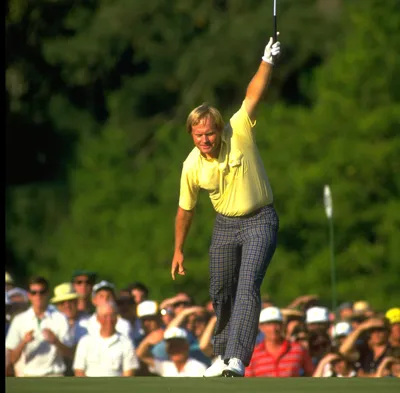
The 16th has arguably produced more drama than any other hole at Augusta National. Tee shots are hit entirely over water to a right-to-left sloping green that's protected on all sides by three bunkers. When the flag is located it its traditional Friday position on the front right of the green, it is extremely difficult to get close. However, when the pin is back left, players can aim 20 feet right and let the slope of the green take the ball down to the hole - the strategy employed by Jack Nicklaus in 1986. Since the Masters began, there have been 15 holes-in-one at the 16th. Do: follow the example of Charl Schwartzel, who went straight at the pin, made the second of four consecutive birdies and went on to win the 2011 Masters Don't: do a Billy Casper, who hit five balls into the water en route to a 14 and a round of 106 in 2005.
The 17th - Par 4 - 440 yards
Nandina shares many characteristics with the 14th, most notably its straight, narrow shape and severely sloping putting surface. The Eisenhower Tree sits some 210 yards from the tee, and is so named because the US president - a former member of Augusta National - hit it so often he campaigned to have it removed. After a well-placed drive, a mid to short iron remains to a green that is shaped like an upturned bowl. Distance control is key on approaches, as balls often spin back off the front of the green. Do: imitate Nick Faldo, who followed a birdie at the 16th with another at 17, earned a play-off berth and beat Scott Hoch to claim his first Masters title in 1989. Don't: make a double bogey when you are one off the lead, as Justin Rose did during the final round in 2007.

Nick Bonfield joined Golf Monthly in 2012 after graduating from Exeter University and earning an NCTJ-accredited journalism diploma from News Associates in Wimbledon. He is responsible for managing production of the magazine, sub-editing, writing, commissioning and coordinating all features across print and online. Most of his online work is opinion-based and typically centres around the Majors and significant events in the global golfing calendar. Nick has been an avid golf fan since the age of ten and became obsessed with the professional game after watching Mike Weir and Shaun Micheel win The Masters and PGA Championship respectively in 2003. In his time with Golf Monthly, he's interviewed the likes of Rory McIlroy, Justin Rose, Jose Maria Olazabal, Henrik Stenson, Padraig Harrington, Lee Westwood and Billy Horschel and has ghost-written columns for Westwood, Wayne Riley, Matthew Southgate, Chris Wood and Eddie Pepperell. Nick is a 12-handicap golfer and his favourite courses include Old Head, Sunningdale New, Penha Longha, Valderrama and Bearwood Lakes. If you have a feature pitch for Nick, please email nick.bonfield@futurenet.com with 'Pitch' in the subject line. Nick is currently playing: Driver: TaylorMade M1 Fairway wood: TaylorMade RBZ Stage 2 Hybrid: Ping Crossover Irons (4-9): Nike Vapor Speed Wedges: Cleveland CBX Full Face, 56˚, Titleist Vokey SM4, 60˚ Putter: testing in progress! Ball: TaylorMade TP5x