Why Is Shinnecock Hills' 11th Hole Dubbed 'The Shortest Par 5 In Golf'?
The par-3 11th at Shinnecock Hills is less than 160 yards long, but it ranks among the most fearsome holes on the planet for even the very best golfers

The 2026 US Open layout, Shinnecock Hills, measures 7,440 yards in total and plays as a par-70.
Both par-5 holes on the Long Island layout surround the 600-yard mark, but they don't trouble the world's best professionals who possess an abundance of length in the modern era.
And one of the four par 3s stretches out beyond 250 yards - joining the cluster of other US Open holes which are akin to drivable par 4s for the humble amateur.
Yet, it's the shortest hole on the golf course which strikes genuine fear into each of the 156 players in the US Open field this week. Plus everyone else who has ever been lucky enough to play it, in all fairness.
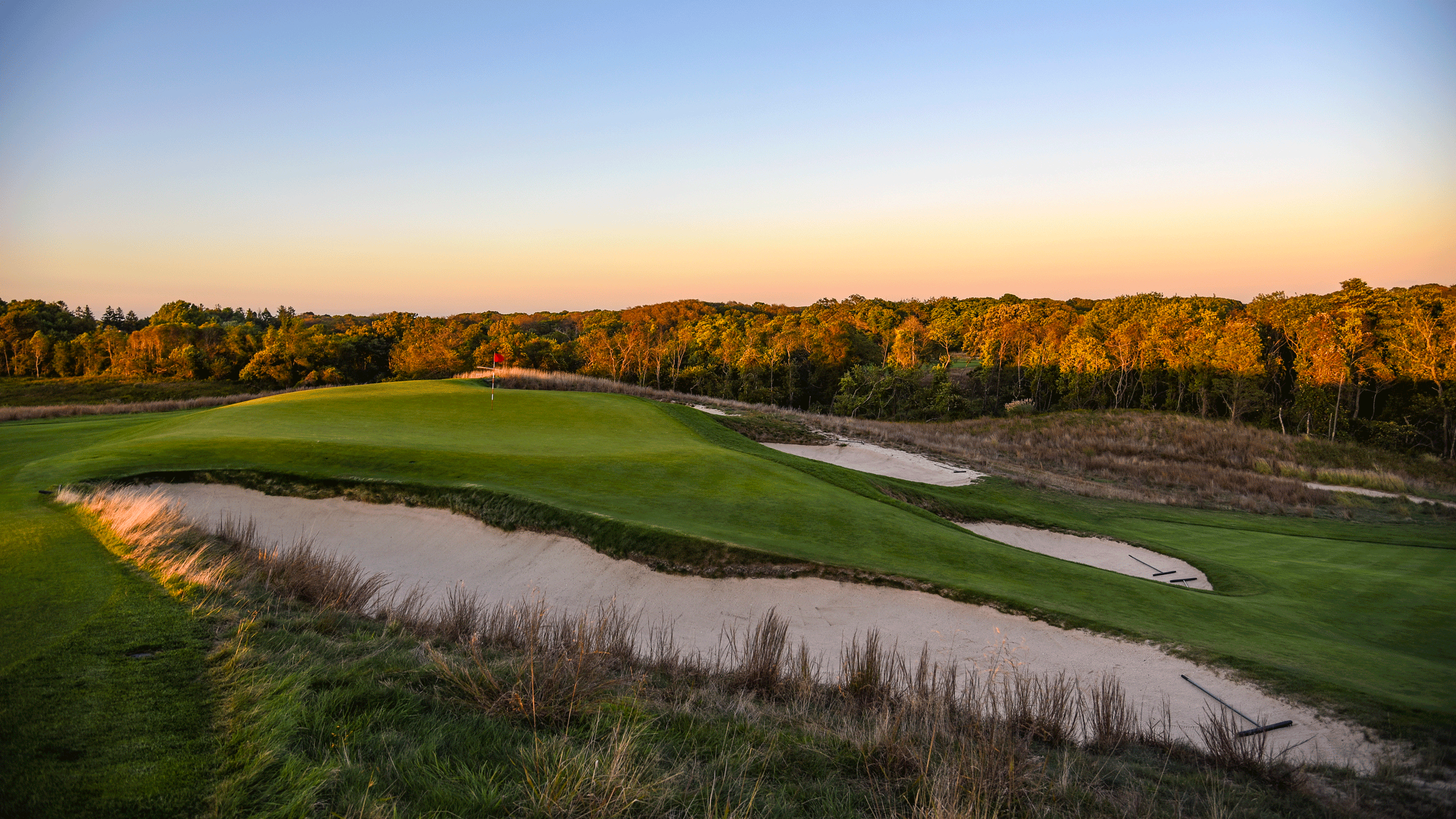
Called 'Hill Head', Shinnecock Hills' 11th hole is a par 3 which will only measure between 150-160 yards throughout the championship. A mere flick with a short iron, or possibly even a wedge, in theory.
Yet, it's when we pull back the curtain a little more that we come to realize exactly where the players' anxiety is born from.
Firstly, the green is only 4,280 square feet. That makes it the smallest putting surface on the property - one which is around 60% of an average green at Shinnecock.
Then there's the fact the green is 17 feet above the tee box, so it makes it tough to land the ball on target (and keep it there).
Oh, and did I mention that's also the highest point of the course? So when the wind blows across this completely unprotected point of land on the eastern side of Long Island, conditions are often the toughest right there.
Continuing on, the green's shape and contours are hardly conducive to attracting golf balls either - preferring to repel them to longer cuts elsewhere.
There are also four large and welcoming bunkers protecting the front half of the green complex, which itself can run at well above 11 on the stimpmeter (on a day where the USGA is feeling kind).
Speaking on Tuesday, Rory McIlroy mentioned the greens likely ran at "about 11.5 during practice but could drop to 10.5 or so when the wind picks up during round one.
He said: "I'd say the greens [on Monday] probably averaged about 11.5. They certainly don't need to be any faster than that.

"I think with the wind they're expecting on Thursday, I'd say it seems they'd want to get the greens back to the 10s. 10.5, something like that, just because of how heavy the wind is gong to be, gusts of 35 to 40 miles an hour.
"There was only gusts of 25 to 30 yesterday, and balls wouldn't stand on the 11th green. That's where you just have to use a little bit of caution."
But ultimately, all of the aforementioned factors add up to a par-3 which has regularly averaged over par in each of its five US Opens so far. In round one of the 2018 US Open, for example, it average almost 0.5 strokes over par at 3.4744.
Lee Trevino once famously titled this hole "the shortest par 5 in golf" and Brooks Koepka agrees. The 2018 US Open champion made a world-class bogey there in the final round to ultimately help him triumph on one-over for the week.
The five-time Major winner went long and left into a run-off area before deciding to cross the green with his second shot on purpose in order to set up an up-and-down from one of the front bunkers. He managed it, and the rest is history.
Asked for his thoughts on the same hole ahead of this week's championship, Koepka joked: "Probably would start by not hitting it over the back on the left. That's how I would start that."
He continued: "I think the green complex is so undulating, so small, it's very difficult. If you're going to miss it, you've got to miss it right. I think that's the first thing you've got to do.

"From there, it's just a good par-3. You've got to be precise with your distance and your accuracy. I think it's a good challenging hole, and you can walk away with five very easily."
Although the fear is real from the pros, there is also a great deal of respect for the enduring par 3.
Adam Scott, who is making his 100th consecutive appearance at a Major, shared praise for Shinnecock's 11th hole after being asked if there are any shots he spends more time practicing here than normal.
Smylie trying to take on the 11th green at Shinnecock 🙈 pic.twitter.com/VFVvk3D17dJune 16, 2026
Scott said: "Yeah, I think there are quite a lot of shots here. I don't know if it's the most iconic shot, but the second shot into 10, I think is fascinating, and it's mostly a wedge. It's not often that we get scared with a wedge.
"The 15th at Augusta has turned into one of those if you lay up. But the 10th here, and then right again the 11th here, I think it's fascinating. We've got a short hole, a short par-3, and you're really scared on the tee, and you've got a 9-iron maybe.
"So we play so many 220-yard par-3s over water. I think the fact that a 150-yard hole scares us is brilliant."
