How Does The Cut Rule Work At The 2026 US Open?
There have been many changes to the cut rule at the US Open over the years, but this is how it will work at Shinnecock Hills in 2026...

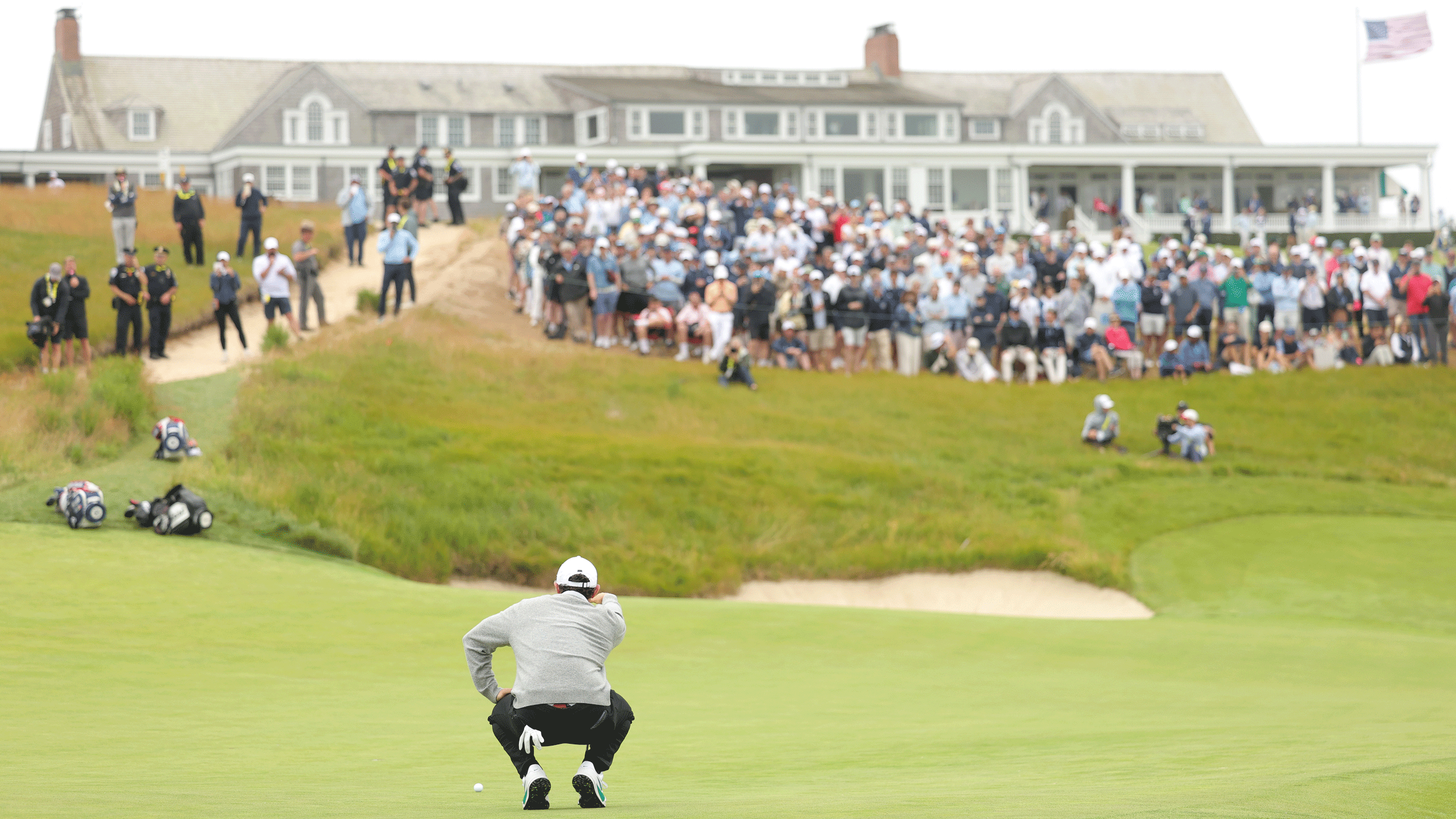
The US Open is not like your typical PGA Tour event, where the winning score is usually well into double digits under par.
The players teeing it up at Shinnecock Hills this week are facing something like the usual demanding test that comes with playing in a US Open - thick rough, firm and fast fairways, and very slippery greens.
Typical US Open conditions might have taken a bit of time to bed in, given the USGA were wary of making the course unplayable with high winds in the forecast at Shinnecock, but scoring is still undoubtedly difficult and an even par round is not to be scoffed at.
And with a number of big names scrambling to make the cut on this iconic Long Island layout, it seems as though the USGA has done an excellent job in letting Shinnecock Hills be the star of the show - just as it had intended.
But brutal conditions inevitably lead to shock performances. Defending champion JJ Spaun is staring down the barrel of an early exit, as is 2022 Open champion Cameron Smith. Fellow LIV golfers David Puig, Graeme McDowell and Joaquin Niemann also began round two with plenty of work to do.
As for the cut rule, it will be the top-60 players and ties after 36 holes who make it through to the weekend and earn the chance to play for Major glory.
At The Masters, which typically starts with a field of fewer than 100 players - compared to 156 players at the other three Major Championships - it's the top 50 and ties that progress.
Meanwhile, at the PGA Championship and The Open, it's the top 70 players and ties who make it through after 36 holes.
Prior to 2012, the US Open had implemented a 10-shot rule, under which any additional players within 10 shots of the lead would also make the 36-hole cut.
However, this rule was scrapped to keep too many players from making the cut and slowing down the pace of play. At Oakland Hills in 1996, 108 players made the cut - a record which will almost certainly never be surpassed.
Last year, at another very demanding layout in Oakmont Country Club, a remarkable seven-over-par proved good enough to make the cut.
But, judging by Chief Championships Officer John Bodenhamer's comments prior to this year's tournament, scoring at Shinnecock Hills is not expected to be so high.
The USGA are keen to avoid a repeat of 2018, the last time the US Open was played at the Long Island venue, when it faced strong criticism from the players. In that year, the cutline came at eight-over-par - although it was even higher in the 1986 contest, when it moved out to 10-over.

Brooks Koepka high-fiving his caddie on the 18th green at the 2018 US Open
The highest 36-hole cut line since World War 2 arrived in 1955 when a remarkable 15-over was good enough to make the weekend at The Olympic Club in San Francisco.
On the flip side, recent US Opens have featured among the lowest 36-hole cut marks ever.
Before Wyndham Clark triumphed at LACC in 2022, the cut was made at a poultry two-over-par on the par 70 layout. The very next year, it was just three-over before Matt Fitzpatrick went on to claim his maiden Major at Olympia Fields in Illinois.
The lowest cut score (in relation to par) at a US Open is jointly held by Medinah in 1990 and Erin Hills in 2017 - both of which featured players at +1 as the final crop who sailed through.
