US Open Playoff Format Explained: What Happens If There's A Tie
If it's all square after 72 holes, here's what the golfers at the US Open will have to do in order to claim the top prize


Every golfer will be fighting to the last hole to be in contention for the US Open title at Shinnecock Hills, but there can only be one winner in the end.
With 18 holes remaining, Wyndham Clark held a six-stroke lead over his nearest rivals, but things can change in the blink of an eye in a Major championship. Especially one played as such a difficult test like Shinnecock.
So, if the chasing pack do indeed catch up with the 2023 winner, and the scores are level after 72 holes on Sunday, what will happen?
We actually haven't had a playoff at the US Open since way back in 2008, when Tiger Woods defeated Rocco Mediate in an 18-hole playoff.
In fact, that particular decider went to 19 holes for a total of 91 gruelling holes completed for the week, but that's not how it works these days.
US Open playoff format: how it works at Shinnecock Hills in 2026
Now, the US Open winner would be determined by a two-hole aggregate playoff. If the scores are level after two holes, a sudden death format would come into play.
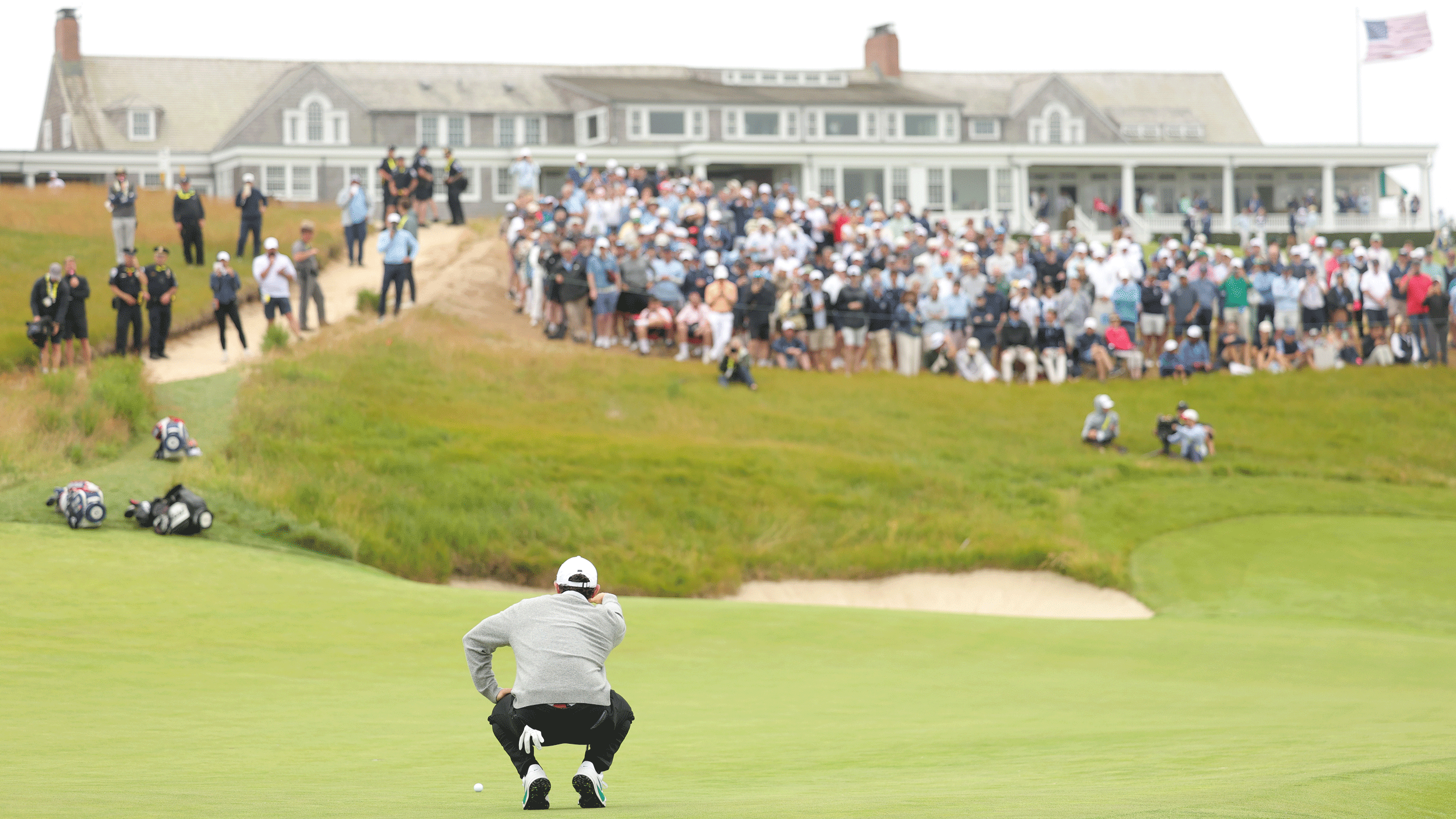
At Shinnecock Hills for the 126th US Open this year, it will be holes 17 and 18 that are used for such a playoff.
Hole 17 is a 176-yard par-3 with a green that sits on a right-to-left angle and a bunker right down the center line. It's a deep green, too, and depending on the hole location we could see it play more like 185 yards.
Meanwhile, hole 18, aptly named Home, is a 490-yard par-4 with a complex green that undulates in all directions. Misread your putt on there, and you could find yourself rolling slowly off the green entirely.
Interestingly, the two-hole aggregate approach is different to the PGA Championship playoff format, for example, which uses a three-hole aggregate. The Masters goes straight to sudden death, while The Open Championship goes for a four-hole aggregate.
US Open Playoff History

From 1939 to 2008, the 18-hole playoff format was utilized for the US Open, with golfers often having to play through to Monday to decide the winner.
Tiger Woods and Rocco Mediate did just that in 2008, with Woods ultimately triumphing by one stroke after 19 holes at Torrey Pines, in spite of playing with a broken leg!
The only other playoff in the 21st century came in 2001 at Southern Hills Country Club. Retief Goosen won there with a round of 70 to beat Mark Brooks, who shot 72 in the extra 18 holes.
1994 saw a thrilling three-way tie between eventual champion Ernie Els, runner-up Loren Roberts, and Colin Montgomerie. While Montgomerie fell away with a 78 after 18, it took two more holes to separate Els and Roberts.
Many, many years before that, we saw Jack Nicklaus defeat Arnold Palmer in 1966 with the former winning by three strokes in the end. This was a real shift in the dynamic of golf, with Nicklaus going on to dominate from there onwards.
A few years later, in 1971, Nicklaus was trumped by Lee Trevino at Merion Golf Club. But, it wasn't just the golf that makes this a famous win, more the fact that Trevino threw a toy rubber snake at Nicklaus on the first tee.
It's worth noting that, between 1928 and 1931, a 36-hole format was in use at the US Open, but the USGA soon reverted to the 18-hole playoff before the rule changed to the current two-hole approach in 2018.
