






5 Things I Learned From My Golf Lesson With Lee Westwood (That Will Help Every High-Handicapper)
Former World No.1 Lee Westwood gave me a golf lesson recently, but his invaluable tips could be the key to lower scores for all high-handicap golfers
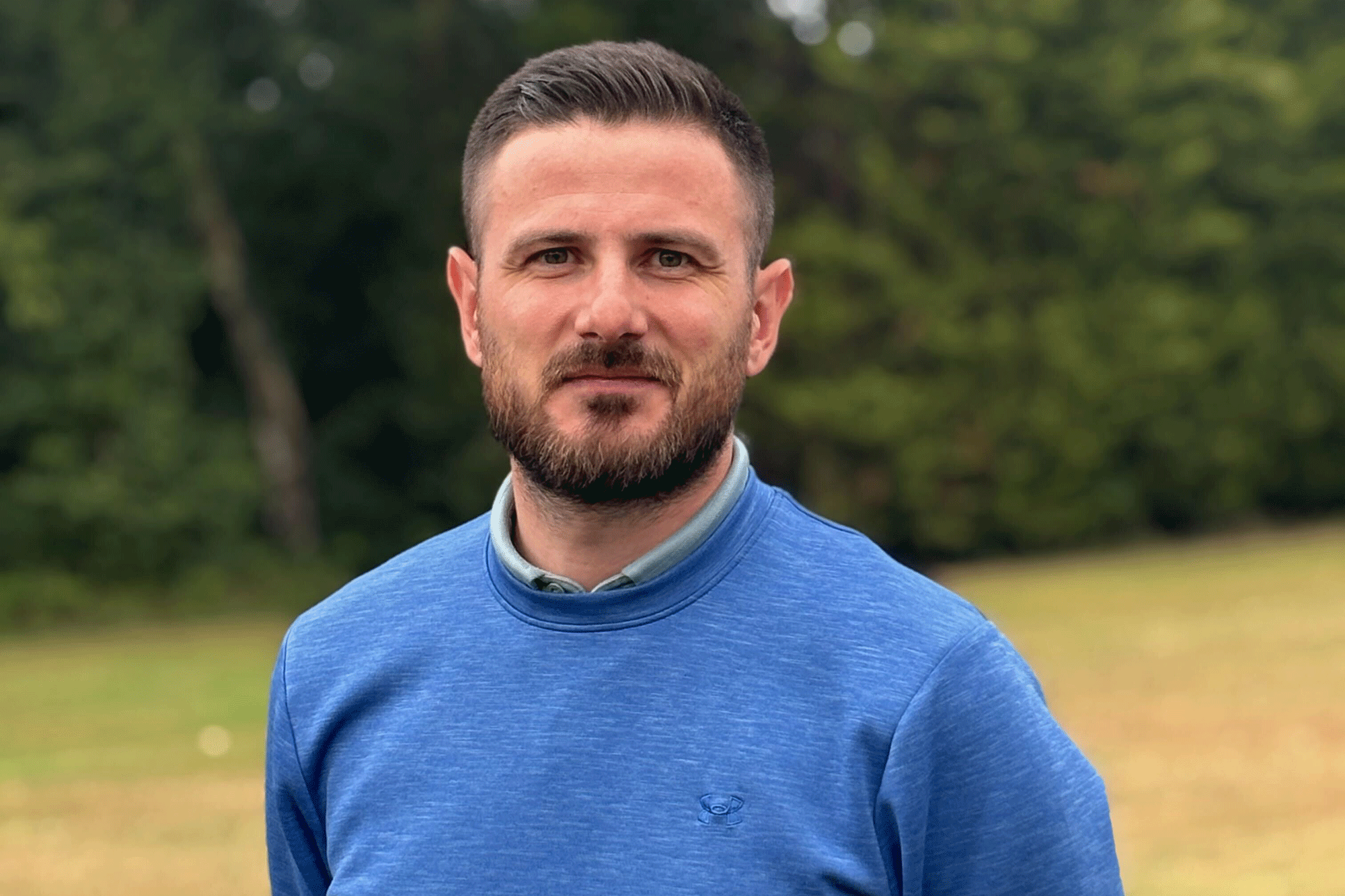

It's not everyday that an average high-handicap golfer gets the chance to receive a golf lesson from a former World No.1 and Ryder Cup legend, but that was the fortunate position I found myself in at Close House recently - when Lee Westwood agreed to help me with my game.
I benefited hugely from a winter golf rebuild that allowed me to utilise the off-season, with some pretty impressive results, but there is still plenty to do in order to cut my handicap in 2026.
Golf gym exercises helped me to gain a 106% power boost, while swing work and custom fit golf clubs have given me the tools to break 90 for the first time - but I was excited to hear what advice Lee Westwood could give me to supercharge my progress.
The tips in this video and article are absolute gold for high-handicappers, shared by one of the greatest European golfers in history.
His simple strategies and solutions to common faults could help you to shoot lower scores this season... they certainly did the trick for me!
5 Things I Learned From My Golf Lesson With Lee Westwood
1. Preventing A Slice

The arms separate from the body in the backswing so you have to reconnect on the way down
Like most high-handicap golfers, I struggle with a slice off the tee.
This doesn't always occur, as evidenced in the video of my lesson where I flushed one down the middle, but when the common fault rears its ugly head the results can be rather unpleasant.
As Lee Westwood explained, there are a few red flags that can cause a slice for an amateur golfer.
"They often don't get behind it enough in the backswing and then they try to pull the club through.
"That means they are always continuously holding the face open and never allow it to square by releasing the club".
I asked the Former World No.1 if he could share any advice for amateurs who wanted to banish a slice, either through practice on the range or on the course, and he gave a brilliant answer that will help many to achieve just that.
"I normally think about it as synchronising the arms with the body on the way down. Most people go with their body too fast, so wait a little bit at the top (of the swing) and allow your arms to come down before your body starts doing anything.
"The hardest thing in the golf swing is that your arms separate from your body on the way up, so at some point you have to reconnect on the way down. The easiest time to do that is in the first part of the downswing. Just let them reconnect and then turn.
"Most people get to the top and then go with their body, which leaves their arms way behind and means the club never squares up. The result is a shot that starts right and goes right".
2. Alignment

I learned so much from watching a top professional go about their business on the golf course
After finding the middle of the fairway I had 145-yards in to the flag on the 1st at Close House.
With Westwood watching on, I was hoping a little adrenaline was going to help me penetrate the wind and find the putting surface - but once again an old foe fought back and I never started it on the right line.
Alignment is a bit of an achilles heel for me, and other high-handicap golfers, but Lee Westwood gave a couple of great tips to improve in this key area.
"A problem with the modern game is that most people won't hit on a grass range. They might hit from a mat, or in a golf simulator, but that means you can't learn from your divots. It's a bit of a lost art, reading your divot to tell you what your swing is doing".
My divot was slightly from the inside and pointing a bit to the right, but it was square as opposed to thin. That meant that I had squared the face, but my alignment was slightly off. That's a problem that I can fix before I even touch the ball, as Lee explained.
"If you make a mistake in the first part, to do with your posture, setup or alignment, you have to make compensations somewhere else in the golf swing - then you've got two mistakes rather than one.
"The best way is to pick something on the ground about three or four feet in front of you. This can be a blade of grass or an old divot.
"It starts on the range. Most people will go and hit a bucket of 50 balls, pulling each across and hitting it. I will never do that.
"I would put the ball on the ground, stand behind it, line up, walk in and set up to it. All the time I'm grooving it and drilling myself, but it might take me three or four times longer to hit 50 balls than it would an amateur".
3. Bunker Play

Bunker shots have been a problem area for me, but Lee's tips have boosted my confidence from the sand
When I have previously had lessons on how to hit shots from the sand, like a particularly poignant example of tuition in a deep revetted bunker at Turnberry Golf Club, the key points were getting a good wrist hinge early and committing through the sand.
The general premise of that lesson aligned with the tips that the Majesticks GC Co-Captain gave me in a greenside bunker on the Lee Westwood Colt Course, but I also needed to address a couple of other issues.
"It starts off with the setup. You want your weight more in your lead side and you want your ball position further forward because you've bumped your weight forward. You also need to open the clubface".
After two attempts, I barely got out of the sand. That was no reflection on Lee's tips, because as he correctly pointed out there was another significant issue with my entry point into the sand.
"If it drops off the face (and barely gets out of the bunker) it's likely that you pulled the club face across - taking all the speed out of the clubhead.
You will see in the video that the divot left in the sand by my shot, compared with the one next to it from Lee's shot, are completely different - and he expertly explained why.
"You see I've made a big splash. You leant, pulled across and your divot was very narrow and thin. Mine is big, like a dinner plate. When you use the bounce on the club it will prevent it digging.
"See how it's stayed shallow, but I've taken a lot of sand because I've used the characteristics of the club as they were meant to be used".
4. To Putt Or Not To Putt?

Having a clear strategy is important, but you need to consider speed and break to eliminate those costly three-putts
I think we could describe my short game as inconsistent - at best. The shots that worry me the most are often the ones that look the easiest, with no danger and plenty of green to work with.
In that scenario, like the one I found myself in at Close House in the video above, I question myself over and over again about which club to take, what style of shot to play and how I might execute it.
This results in a lot of indecision and usually a poor effort regardless - so I asked Lee Westwood to help me with some pro advice.
"I would putt it, so I'd also advise you to putt it - there's nothing in your way. If you take out a sand wedge or a lob wedge, you have to factor in spin and what it's going to do when it lands on the green.
"There are more variables if you are going to chip it, whereas you know what it's going to do if you putt it".
Once we had determined that putting was the best course of action, the 25-time European Tour winner talked me through an important point about speed and break.
"When you hit the putt, the fastest it's moving is at the start and it doesn't swing as much when it's moving fast. All the curving will be done as it slows down".
After picking my start line and highlighting the point where it will start to break more on the green, I hit a putt that got me closer to the hole than any chip I could reasonably have produced. Result!
5. Fundamentals

So much of the success in a golf shot is determined by what you do before you hit the ball
One of the biggest takeaways from my golf lesson with Lee Westwood was that I needed to seriously focus on the fundamentals.
These are simple changes - like using an alignment stick to practice on the range, ensuring my setup position is more athletic and my stance is a little wider, or that my shoulders are not wide open at address - but they take work to become habit.
Making adjustments to the elements I can control, like all of those examples before I have even touched the golf ball, will help me to cut my handicap and shoot lower scores - and I am certain they will also help you to do the same.