






I Lost My Distance When I Hit My 40s. Here's How I'm Getting It Back
Single figure golfer Carly Cummins is winding the clock back with a new fitness plan to regain power and distance


At the start of the summer I was told that I wasn’t a long enough hitter to be selected to play in my county first team during match week. We were playing at East Devon Golf Club, a long and demanding links course. Length mattered and I was the shortest hitter on the team. As a consequence I ended up caddying for the week.
I carry the ball around 195-200 yards, but on firm fairways with run, my drives roll out to 220 yards maximum. For comparison, the longest drives on the LPGA Tour can average over 280 yards.
Many of the county players I compete against regularly hit their drives 50 yards past me, which means that they can easily reach par-5s in two, while it nearly always takes me three shots to get to the green. The advantage is obvious.
I went away from match week disappointed but determined to do something about my lack of length. So for the last few months I have worked on my strength at my local gym by attending a group weight lifting class twice a week followed by a stretch class afterwards.
I set up my weight station at the front by the mirrors to make myself accountable, no hiding. I’ve slowly increased my weights as advised by the class instructor week upon week, to the point at which I’m now lifting heavier weights than most in the room, even some of the men.
I’m stronger and my muscle mass has increased, my arms look more muscular and toned, as do my legs and back. Towards the end of the summer I started to reap the rewards. I began hitting the ball a little further, about half a club distance gain with my irons. I felt stronger. I also noticed that my golf stamina had improved, my overall fitness was better.
My long-time county foursomes partner and I play in the south-west scratch foursomes every year and she was impressed at how much further I was hitting my tee shots in the space of the year since we had last played the tournament together. She told me I was back to my old self again.
I’ve never been a long hitter, but what I hadn’t realised was how much power I had lost since hitting my 40s. There’s no doubt that entering perimenopause had drained me of testosterone, strength and power.
I recorded my best score of the 2025 season just a couple of weeks ago. I carded a two under par round at my home course Parkstone in Dorset, lipping out narrowly for a three-under par 69 that would have matched the course record I already hold at the club.

Carly Cummins has been lifting weights for the last few months
I’ve always been a firm believer that if you work hard in life you’ll be rewarded, whether that be in your career, your home life or your pastimes, whatever it is that you put your mind to. Some might say that my county captain was a bit harsh, telling me that I wasn’t long enough to play in the first team squad. But it gave me the motivation to try to get my length back to the level it was at in my 20s.
I’m by no means there yet. I’ll continue to work on my strength and swing speed over the winter months, so that I emerge next spring even stronger and longer. I’ve recently sought the advice of specialist golf personal trainer Jamie Greaves. He is a firm believer that with the right training program and routine; even in just 10 minutes a day at home, you can make physical transformations that will increase your driving distance, no matter what your age.

Jamie Greaves is a strength and conditioning coach and an avid golfer. He played college golf in America, where he reached a handicap of +2. Whilst playing in the States, Jamie discovered a love for fitness and how proper training can positively influence your golf game. Now TPI Fitness Level 3 Certified, Jamie has his own studio at Northampton Golf Club.
“The physical peak for our bodies is around age 29-30,” explains Greaves. “After this age we are losing range of motion, losing muscle mass and as a consequence maximum strength and we’re also losing force production - those fast twitch muscle reactions. Our ability to move fast.
“If we do nothing about this from age 30 onwards we’re essentially getting weaker and slower, which means you’ll hit the ball shorter. The older we get, the faster those athletic qualities decrease. From age 50 onwards, the rate at which we lose these qualities accelerates.
“The link between clubhead speed, distance and handicap are quite well documented. The good news is, if we train these qualities they definitely don’t need to diminish. In fact, for most people they can go the other way and even into your sixties and seventies you can add mass, you can add explosiveness and speed.”
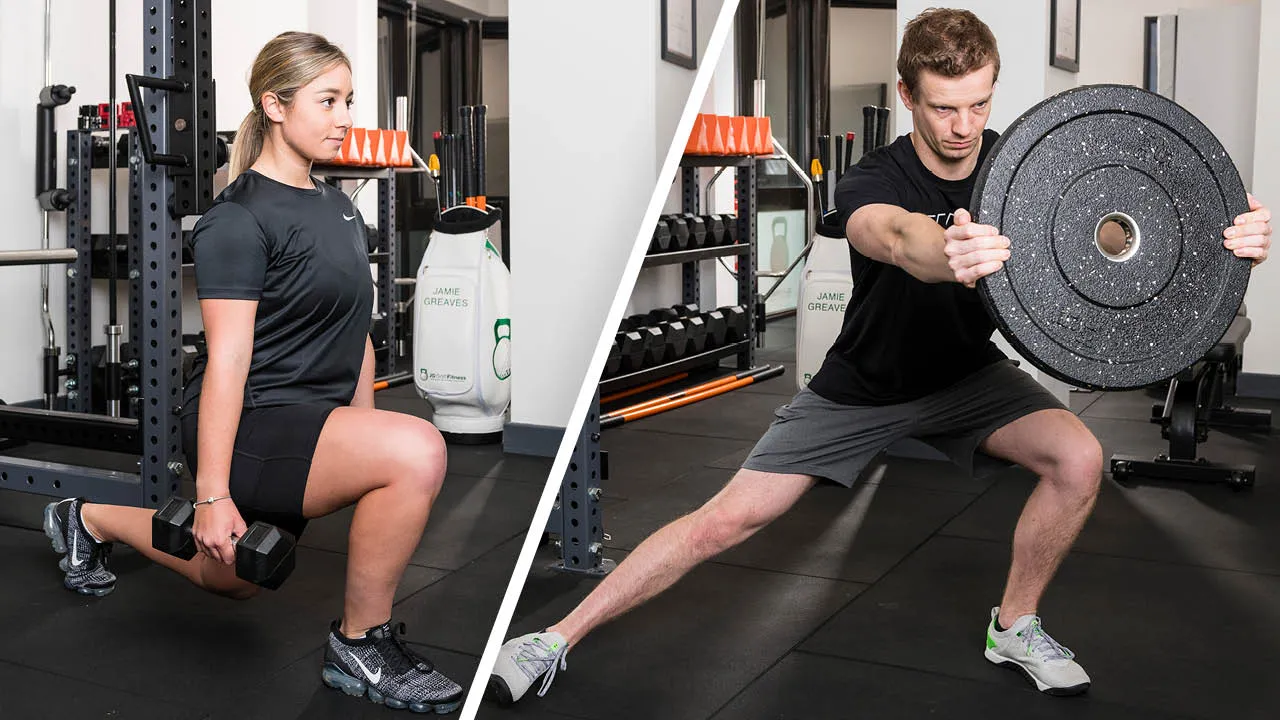
Three keys to adding distance - strength, flexibility and speed
One of the pressing questions I had for Greaves was the main differences between men and women. Could I genuinely add as much power as a man?
“Men are generally pretty strong through their upper body but consequently quite stiff,” he explains. “They usually need more lower body strength and power and a lot more range of motion and freedom through the trunk.
“Women tend to move better. They are more mobile. They are also a bit stronger and more explosive through their lower body. However, their strength lacks more in the upper body. This is the lowest hanging fruit for them.”
Talking to Greaves it became apparent that there are really three keys to adding distance - strength, flexibility and speed. And while I’ve been addressing the first two elements with my own gym training, I hadn’t considered the all-important need to swing the club quicker. My clubhead speed is around 80mph, even a 5mph increase could add 10 yards to my length. So what does training for golf involve?

Speed work involves throwing a medicine ball
“You need a good range of motion, mainly through the trunk, hips and shoulders,” insists Greaves. “This can be achieved in many different ways - through targeted mobility, movement work or it could be going to a yoga, Pilates or stretch class. Whatever way, you should be doing some concentrated work each week to improve your mobility and range of movement.
“Where a lot of golfers go wrong is that they leave it there. They just do mobility work. They think it’s the most important thing. But when we’re looking at distance in particular, strength and force production matter more. The ability to move fast.”
According to Greaves, speed work involves things like throwing a medicine ball and swinging a stick, along with explosive lower body movements like hops and jumps. “The worst thing people can do is just try and replicate the golf swing in the gym,” he adds.
“The good news is that strength and power are linked, so as you get stronger you should be able to produce more force. What most golfers realise is that the speed in the swing happens in a split second.
“A highly elite player gets about 0.6 of a second to generate their force, this reduces to about 0.3 of a second in typical amateurs,” Greaves insists.
He’s referring to the time it takes the club to move from the top of the downswing down into impact. The difference is the best players in the world start their downswing shifts as the club is going back.
Greaves has created a selection of simple exercise programs you can follow at home to get you started. To find out more about his fitness programs visit: www.jggolffitness.co.uk
