






5 Bad Golf Habits You’ve Picked Up From YouTube (And Why They’re Ruining Your Swing)
Why online tips often lead to information overload, ruined mechanics, and higher scores. How to separate good advice from swing traps


Knowledge is a wonderful thing and it can 100% enhance our lives and our golf games. But when golfers go ‘fishing’ on YouTube for the secret move that will turn them into the best golfers ever, a red flag goes up.
Every other new pupil I meet starts the conversation with, “I always go on YouTube and I’ve tried everything.” Often we spend the lesson almost Etch A Sketching their minds to try and gather focus. Then we work on what is specifically applicable to them as golfers and human beings.
Why isn’t the cure for your slice (along with the 14million other golfers) working? YouTube doesn’t get to the root cause of a problem. Your lower back issues and poor posture haven’t been addressed.
Instead, it’s straight in with how to cure an out-to-in swing path. You’re doing all the drills and still shouting “Fore!” I’m sad to say, you’ll continue to shout and your back will likely get worse because at no point has someone told you to warm up properly to inject some athletic posture into your set up to enable your bigger muscles to get involved.
I learn so much about a pupil by talking a lot at the start of a lesson. Asking all the right questions and learning what makes them tick. Then and only then do we hatch a plan to get to root causes and ensure the golfer knows why they have an issue. We formulate a personalised action plan to get them back on track and none of this involves watching any more YouTube videos other than those specific to them.
Don’t get me wrong, there’s some brilliant content and lessons to be learnt online, but none of it is taking into account who you are and what you're physically capable of. These are the 5 most dangerous lessons that golfers glean from trawling through hours of YouTube videos.

Information Overload
Have you tried tapping your head and rubbing your stomach? Well add another 3 or 4 activities into this and then try hitting a golf ball. That is what so many golfers try to do! Adding more information to a brain that is already bleary with theory is a recipe for absolute disaster.
We need a quiet mind and minimal tension to consistently strike the golf ball. This is never going to happen if you are thinking and doing. This is why lessons are so important. Even those golfers who earwig into lessons someone else is having on the range, suffer with adding yet another move or swing thought. Often it’s something that exasperates existing swing faults and sends their golf further into despair.
No.1 rule - focus on yourself and your own problems. A lesson with a PGA pro is the only way you’re going to get your game back on track. Whether it’s an online or in-person lesson, find a coach you gel with and who is happy to work with the game you already have. People have many layers, so a coach who can peel back your golf game like peeling an onion, will achieve results with minimal brain ache.
Get The X-Factor
Attempting to create coil and torque as if you were as flexible as Nelly Korda is often a waste of effort. Golfers who mainly use their arms in the golf swing do so for good reason. They’re stiff as boards and have little or no rotational capacity (or haven’t unlocked it). The arm swing and sometimes overswing is their body’s attempt to create power. Thinking of turning more when you have back problems won’t do you any favours and it’s important that this is supervised by a qualified coach.
Unless you practice yoga every day and are as bendy as the likes of Rory McIlroy, then trying to keep your hips still and turn your upper body against them will likely cause further issues. Yet so many videos talk about the bigger the X factor the further you’ll hit it. I've had pupils who are baffled that they can’t hit the ball further when they can’t touch their toes or see over their right shoulder because of tight hamstrings and a stiff back.

Most amateur golfers are not as flexible as Nelly Korda
Obsessed About Your Ps
Golfers who are obsessive about their takeaway often begin to watch their arms go back and they start to sway to a point where they rarely return to a decent impact position.
An obsession with perfect positions in the golf swing often causes golfers to lose any kind of natural flow, any talent they have as sportspeople, and being overly mechanical about the swing. They become obsessed with checking each position and frustrated when they don’t get the results of flushing their irons the videos promised.
You need someone to take you through drills that will help you get into better positions without having to think too hard about it. The way we all learn varies and you’ll need fixes that suit you. The last thing you need to be doing is striding out in a monthly medal and stressing over whether your left arm is straight when you’re in P3.
So stop obsessing over whether your Ps are correct, you don’t need to regurgitate a text book out there, just relax. If you get so obsessed with takeaway and backswing, often by the time it comes to extending through the ball, there isn’t the energy or brainpower at impact, causing a player to hit at the ball rather than swinging through.
Golfers chase smash factor, a faster swing speed and those perfect numbers. You can’t have it all and often chasing these things to the extreme can have detrimental effects on your game. Get to the root cause of your problems and let your technique grow from there with the help of your coach. The great numbers will follow.

Don't become obsessed with your takeaway and backswing positions
Keep Your Head Still And Down
This is something golfers often assume is the reason they aren’t playing well. A fellow golfer has no doubt told them they need to have a lesson and they’ve responded by saying, “It’s ok, I’ve checked online and I just need to keep my head down.”
Eyes on the ball for a little longer will help, but a completely still head will stop you using your bigger muscles, as many golfers haven’t got the flexibility to rotate around a point. A little lateral movement will help engage the sequence of movement we need to generate power.
The other advice of, “head down,” often sees chins tucked into golfers’ chests and locking out rotation, so arms go crazy and inconsistency rules. If you’re a golfer striving for that stack and tilt action. please go and see a pro in person. You may save your back from all sorts of pressure and realise this isn’t the route for you.
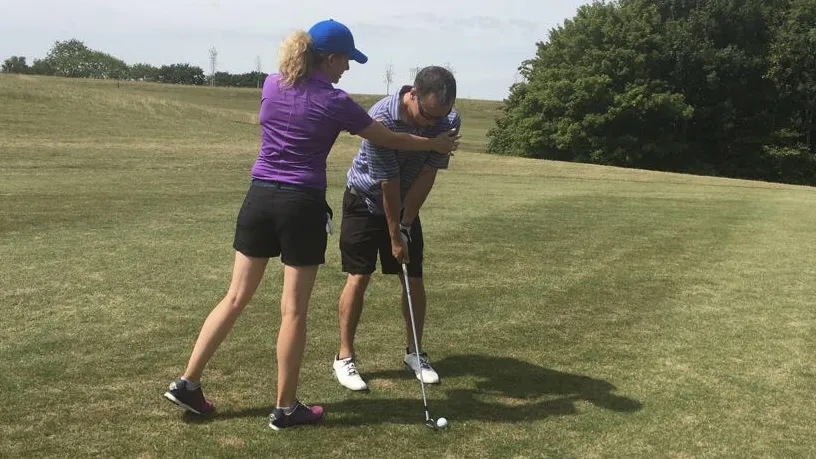
Book a lesson with a PGA Pro to maximise your potential
Moving Ball Position
This is a danger, as moving the ball position affects your shoulder alignment and often sees golfers who aren’t as fit or as talented as tour pros duff it. Especially after watching the Open Championship on the stunning links at Royal Birkdale, many players moved the ball back in the wind to achieve a downward strike and keep the ball flight low for crisp iron shots.
This can make golfers too steep on their downswing. It can also cause injury with thinned and fat shots. So beware the copy cat syndrome. Just because you’ve got Open fever, don’t move your ball too far back before consulting your coach first.
The flop shot is another one that’s marvelled at online. Players open the face on their lob wedges, move the ball way forward in their stances and somehow expect to just slide the club underneath.
This often results in a very poor hit and a bumper score. Don’t try and hit it like the pros, as this is risky. They practice for hours every day and have a brilliant technique. Keep it simple, ball in the middle, weight forward and a shorter swing with your most lofted wedge. Get the basics right before getting fancy.
There are so many other areas that golfers dive into within YouTube. Constantly adding more information and complication. You can learn so much that’s true, but how much is too much? Have a lesson with a pro and let them advise you of some of the best YouTubers to follow who do keep it simple and who can compliment what you’ve been working on within your lessons.
