






Pro Golf Has A Distance Problem... But What Can The Game Really Do To Curb It?
Players have been hitting the golf ball farther and farther over recent years, causing a debate about whether something needs to be done and, if so, what?

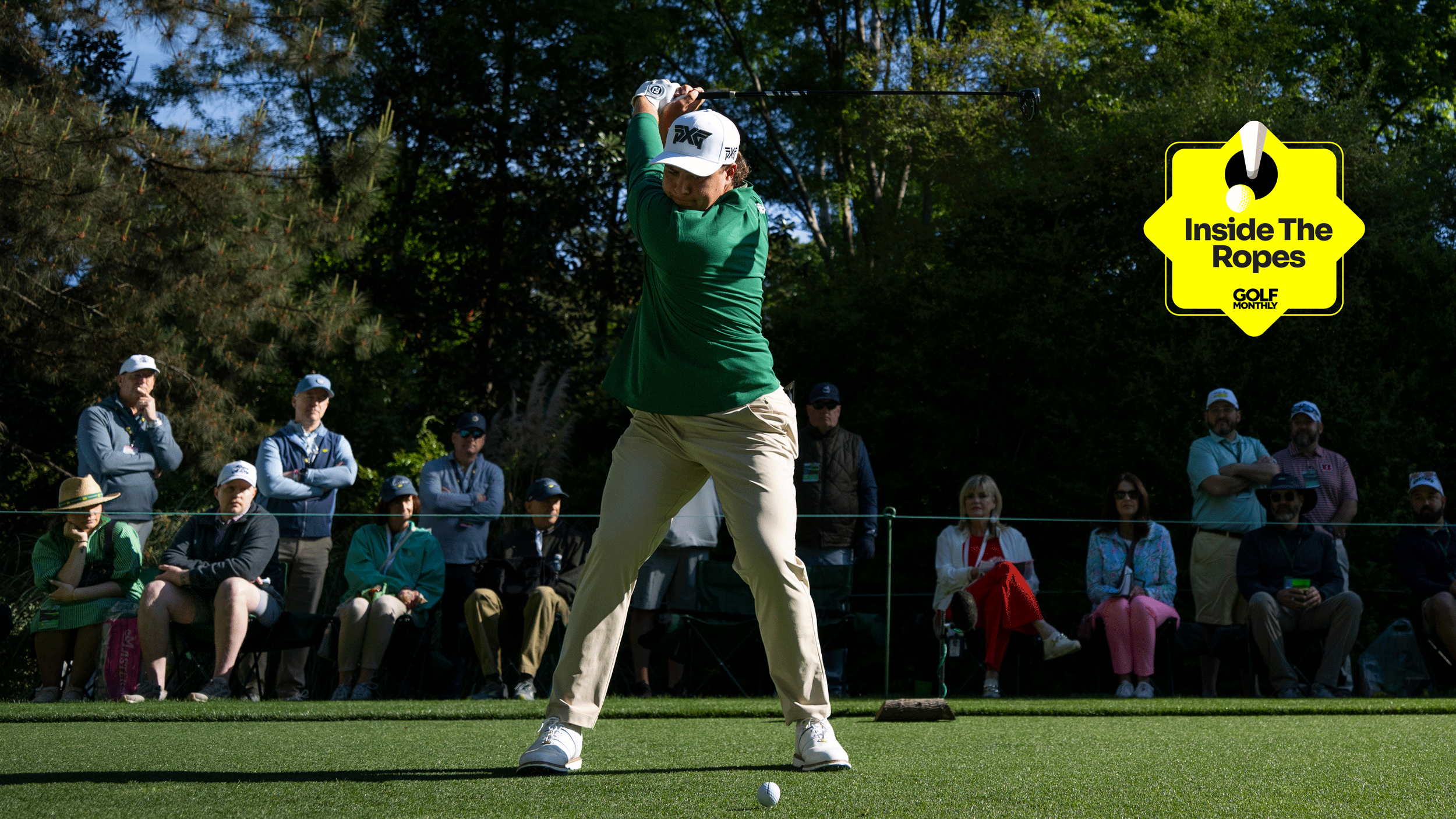
'Inside The Ropes' is the chance for Golf Monthly's expert team to share its honest thoughts on the biggest subjects in the game. This week, we discuss what can be done about golf's distance problem.
The distance players have been hitting the golf ball has been increasing steadily for decades, and the debate regarding what to do about it has been ongoing for years already.
On the PGA Tour, the average driving distance in the 1996 season was 265.9 yards. Fast forward to the 2015-16 season and it was exactly 290 yards. To date in 2026, it's currently 303.9 yards.
With golf balls traveling greater distances, many classic courses are simply being overpowered in the modern era and the entertainment factor is sorely lacking at some events.
Not only that, but most layouts around the world have needed to be lengthened which requires more resources and places a greater strain on the planet. And given climate change is an unavoidable factor in our future, something needs to be done. The multi-million dollar question is... what?

Rory McIlroy is one of many PGA Tour pros who is capable of driving the ball well over 300 yards
Options like implementing a golf-ball rollback or shrinking club heads have been touted as potential routes to go down, as has reducing sweet spots or shortening shafts.
But what do you think can be done to curb golf's unequivocal distance issue? Let us know in the comments. For now, three of Golf Monthly's tour experts have shared their thoughts.
HOW WOULD WE SOLVE GOLF'S DISTANCE PROBLEM?


JF: My thoughts are, and always have been, twofold. Firstly, I would absolutely limit the driver head size to 200cc at professional tournament level, which would have a massive effect on the MOI and thus forgiveness.
If players are still confident enough in their abilities to find a centered-enough strike while swinging at 120mph+ which keeps the ball in play on a head that size then good luck to them, they deserve to be 330 yards down the fairway.
The jeopardy this would create in tournaments when, at any moment, a player could miscue and duck hook a ball 130 yards without being rescued by a 460cc AI designed club head would be intriguing to watch.
I believe this would create some necessary separation in that area of the game and truly highlight those with the highest skill level and precision of strike, while others would be forced to slow down to guarantee a reasonable enough impact to keep the ball in play.

JF: Secondly, limiting tee height or abolishing the use of tee pegs altogether would be my other way of dealing with things.
Since the advent of launch monitor technology, fitters and players have figured out the best way to optimize ball flight is by teeing the ball massively high and creating a vastly upward attack angle to launch the ball airborne.
If you can manage spin from there which everyone can now with balls and CG locations then you can enhance your carry and overall distance by significant margins.
If we took this opportunity out of play and accepted that golf was a 'ground game' rather than suspending a ball two to three inches above the surface then attack angles would change and as such distance output would be completely diminished overnight.
Even the longest of the long on tour can't even sniff carrying a golf ball 300 yards from the deck with either driver, mini driver or a strong 3 wood.


A general view of the ninth hole at Colonial Country Club
EH: As Colonial showed this weekend and Aronimink last month, you don't need an 8,000 yard golf course to test the world's best players. Distance has become far too important at many courses in the men's game instead of accuracy.
It doesn't seem like the impending 2030 rollback is going to make a massive difference, sadly, and the change required to seriously rein distance in via bifurcation would take years, so the tours are going to have to take it into their own hands. They should do that by avoiding courses which can be overpowered and therefore offer a soft touch.
Instead, the tours should focus on venues that test all skillsets and place premiums on accuracy, distance control and short game. Finding fairways is a true skill and missing them needs to be a real punishment - whether that's thick rough, deep bunkers, water or trees.

EH: It is the same into and around the greens. Too often pros miss a green and face a simple lob wedge chip shot from ankle-high rough, instead of truly having to grind hard for an up-and-down.
We also regularly see thick rough slowing balls down and stopping them from going into water and other hazards. That is not an example of testing the greatest golfers in the world hard enough and either rewarding or punishing them correctly.
PGA Tour pros are the best players in the world so they should exclusively play the on the hardest courses. Dial up the difficulty and distance won't be as big of an issue.


MC: There are a few ways in which golf can curb the distance problem and, along with the golf ball, I think equipment in general could be looked at and changed to make it tougher for the world's best ball strikers.
Technology in golf is immense, especially when it comes to forgiveness on off center strikes; however, it now means players are still able to produce impressive distances even when the ball is struck nowhere near the sweet spot.
In the days of persimmon heads and balata balls, there's no chance the shot would still fly 300 yards if not hit properly, whereas in this day and age it's quite the opposite. And it's the same with other clubs in the bag.

MC: Iron lofts can be bent so severely that a 6-iron can easily become an 8-iron. A 7-wood, or even a 9-wood, can now be introduced so that the ball can land softly on longer approaches, or be advanced further from horrible lies in the rough.
This club wasn't even a concept decades ago, neither was a mini driver, which can now be put in the bag just in case the big stick isn't behaving. Essentially, there's a club for everything and the game is, arguably, easier than ever, so perhaps a cull on 14 clubs could happen. 14 is too many, so how about a maximum of 10.
Admittedly, it would obviously be difficult to implement this, but it can't be denied that one way of curbing distance is by restricting equipment.


JL: I was all for a golf ball rollback until I saw the recent report about Cameron Young's ball conforming to the new testing conditions and still flying record distances, so either the numbers involved in a potential rollback need to be reduced dramatically (to something like 1996 numbers) or that idea can be knocked on the head.
The most common suggestion appears to be reducing the size of the driver head, which makes a lot of sense and - due to the invention of mini drivers - probably wouldn't be as hard to adjust to as people might think.
Then there is the potential to reign in the length of shafts on clubs and also reduce the size of the large sweet spot in the head, which is great for a mid-handicapper like you or I but seems quite unnecessary for the pros.
But is the answer not actually all of the above? Why stop at simply modifying the ball or dragging back the length of a golf club shaft? Change each of the aspects I've mentioned and suddenly the game looks very different at the top level.
People will moan about it, but people always do. People, and especially golfers, love to complain about something - particularly if it relates to change. I say rip the bandaid off and make wholesale changes for the good of the game.