





How Augusta National's Designer Stamped His Mark On Southern Ireland 100 Years Ago
After a trip to Cork Golf Club, Jeremy Ellwood discovers that the bulk of Alister MacKenzie's work in Ireland took place in and around this southern city


I knew the layout at Cork Golf Club bore the design signature of the famous Dr Alister MacKenzie, as our Irish expert, Kevin Markham, had extolled its virtues to me, strongly advocating a visit.
What I didn't know, but soon did once I started reading up on it, was that the great man has a fairly limited Irish CV, the world-renowned Lahinch notwithstanding, with the core of his clients (nearly half of them) lying in the Cork area.
My chance to finally play Cork arose in April when photographer Kevin Murray and I ventured over, basing ourselves at the conveniently located Radisson Blu hotel under a mile away. We also got particularly lucky with the weather given how hit-and-miss spring was.

Escaping the sand on the par-3 7th at Cork in beautiful spring weather
On the ground, the course is more dramatic than in any photos I'd seen and, dare I say, even warrants the oft-misplaced ‘u' word, ‘unique'. It enjoys a delightful setting on Little Island by Lough Mahon and as you play the gently uphill 1st, it quickly becomes apparent that the highly visual bunkering is a strong feature.
This formed a key part of fairly recent improvements under the guidance of golf course architect Marc Westenborg, whose team has done a fine job.
In taking on the commission, Westenborg's recommendations had been to “adjust the bunkering such that their style at the very least represented some of the features and design philosophies that MacKenzie was well known for. Those being: smaller, deeper bunkers with high, clearly visible sand faces, and surrounds consisting of a series of sharp hillocks, hollows, ridges and swales, with a great variety of differing gradients.”
Not all the bunkers are small, mind you, and if you glance away to your left at the middle part of the course as you play down towards the lough on the 2nd and 3rd holes, something even more striking quickly registers – the amount of eye-catching exposed rock on view, a legacy of the land's former use as a limestone quarry. A lime kiln still stands at the start of the 5th fairway.

The short par-4 3rd plays down to the lough at Cork Golf Club
Don't get me wrong – I've played many a course with rocky outcrops. Windermere springs readily to mind in England, while abroad, maybe Royal Westmoreland in Barbados or the Links course at Belle Mare Plage in Mauritius.
And just two weeks before my Cork trip I'd played Taunton and Pickeridge in Somerset, where the landscape bears the scars (if that's the right word) of open-cast lime mining from its pre-golf course days.
Cork, however, is on a different scale when it comes to the striking impression such a golfing landscape creates, yet despite the unusual visuals, if you hit it reasonably straight, you should largely be able to avoid any undesirable club vs rock contest.
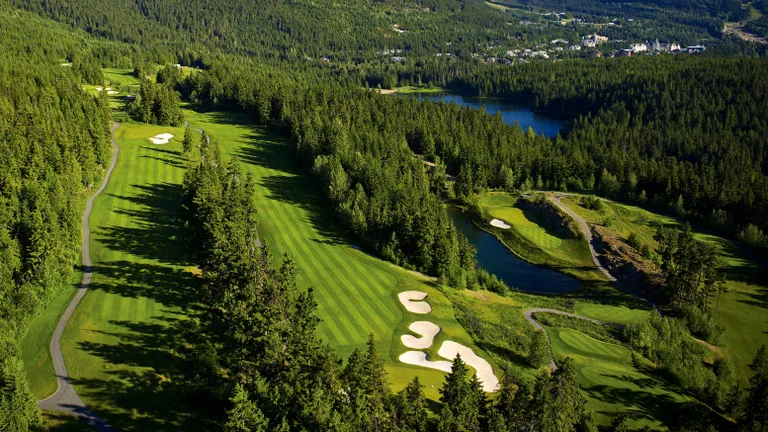
I managed to do just that in my round with Kevin, during and after which he despatched his drone to the skies to capture the lead image in this article and many more.
After hitting the shores of the lough at the 3rd green, you're into the heart of limestone country for the next nine holes, with some absolute treats in store. The 4th tee sits right by the lapping water and, into the wind, it proved a daunting carry back to the safety of the fairway. I just made it.

The 5th green enjoys a beautiful setting at Cork
The green on the par-5 5th then enjoys a fantastic setting by the lough, as does the tee for the 6th, a short risk-reward par 4 with a blind drive and testing approach to a green set below a cliff-face with a house perched on top.
This green rises and narrows towards the back, creating steep banks both sides. I shot an amusing video in which Kevin attempted to get up and down from back right, doffing his cap to the crowd after playing what he thought was the perfect chip... only for the ball to slowly roll off the other side with the camera still rolling.

There is much exposed rock on display around the green on the short par-4 6th at Cork
Exposed rock abounds over the following stretch, especially on the 8th, with the visual bunkering perhaps at its most resplendent on the dogleg-right 12th. To celebrate our return to the holes on the clubhouse side via the shortish par-3 13th, I carelessly sent one into the deep quarry this hole traverses.

The visual bunkering is perhaps at its most impressive on the 12th hole at Cork
“The amount of eye-catching exposed rock on view at Cork Golf Club is a legacy of the land's former use as a limestone quarry"
Jeremy Ellwood
When the club decided on major upgrades after World War I, MacKenzie's proposals were for three brand new holes, while also creating new greens and installing sand-filled bunkers.
The budget was ‘not to exceed £600', which wouldn't get you a lot these days. The work was completed in summer 1925, and showcased his signature undulating greens, large bunkers and distinctive contouring.

A plaque at Cork Golf Club pays tribute to MacKenzie's design work
MacKenzie's work at other Cork clubs
MacKenzie's Cork layout is broadly the one in play today, but his first engagement in the area came at Muskerry, on the other side of town.
Captain Eric Cotter, who hosted Kevin and me here, was quick to point this out when I asked if MacKenzie came to Muskerry when checking out Cork. “No, it was the other way round,” he smiled.
MacKenzie's initial brief at Muskerry was for a new nine when more land became available across the River Shournagh, but it became 11 holes when he persuaded the committee to also retire two of the existing ones.
Among his creations was the truly memorable par-3 6th, which plays across the river from a tee near the clubhouse to a green over 200 yards away off the tips.

You play over the River Shournagh on MacKenzie's long par-3 6th hole at Muskerry
It is, without doubt, a challenge, and one that was once even greater as Eric told us the green used to have an additional shelf up the steep rear bank, which has since been remodelled.
“If the hole is constructed according to my idea,” MacKenzie said before work began, “it should make one of the best short holes in existence and will be of a somewhat similar type to the famous Eden hole at St Andrews.”
The 7th plays across a sideslope to a MacKenzie-designed green. Eric told us no member would ever concede a putt here from above the hole. Two holes later, he pointed out a fascinating-looking abandoned MacKenzie green on the uphill 9th, 80 yards short left of today's green.
The course drops steeply down to the valley floor on the par-3 15th, with the river making its presence very keenly felt over the closing duo.
Your approach must be played over the water on the 17th, while on 18, the river runs along the right before crossing the hole obliquely on the final approach to a green back on the clubhouse side.

The River Shournagh angles across the front of the 18th green at Muskerry
MacKenzie also turned his attention to Monkstown and Douglas Golf Clubs in the Cork area, with this excerpt from the website of Limerick Golf Club (more about which below) succinctly summarising the timeline of his work in the region.
“Muskerry Golf Club... engaged the services of Dr MacKenzie in 1924, and when Cork Golf Club heard he was coming, they also engaged his services to examine bunkering and other aspects. The suggested modifications... were carried out in early 1925 by the British Golf Course Construction Company (BGCCC), which had been established by the MacKenzie brothers to construct Alister's designs.
“He designed a new nine holes for Muskerry and modified two existing holes. He visited Douglas Golf Club in October 1924 and planned some alterations to their course, with the work carried out by the BGCCC in the summer of 1925.
"Further modifications were proposed to Cork in 1925, coinciding with a visit to Monkstown Golf Club to plan a remodelling of the course.”
Club histories and records can be sketchy, incomplete or inconclusive but it seems that while MacKenzie's work in Ireland overall was fairly limited, a considerable percentage of it took place in and around Cork during a condensed spell in the mid-1920s.
I would thoroughly recommend adding Cork to your itinerary next time you're in the south of Ireland.
Elsewhere in Ireland...
Here are three more courses in the country that bear the hallmark of MacKenzie's design hand...
Lahinch (Old)
This fabled County Clare links is ranked 24th in Golf Monthly's UK&I Top 100. MacKenzie was engaged in 1927 to upgrade the Old Tom Morris layout from 1892, and his plans would see all 18 holes on the sandhills side of the road for the first time.
Such was the quality of MacKenzie's design that Martin Hawtree was tasked with undertaking a sympathetic restoration in 1999 following various alterations over the years.

Lahinch is MacKenzie's highest-ranked Irish creation
Limerick
Around the time he was working at Lahinch, MacKenzie was also asked by Limerick Golf Club to improve and extend the 1925 layout created by Lionel Hewson, golf correspondent for The Irish Times.
The club's committee actually contacted the Cork clubs to enquire as to the quality of MacKenzie's work! The MacKenzie holes that survive are the 9th, 10th, 11th, 12th, 13th, 14th, 17th and 18th.
Galway
The club settled on its present Salthill home after a few early moves, with MacKenzie outlining the position of tees and greens in the early 1920s.
In a history of the club for the Carroll's Irish Match Play Tournament staged there in 1969, former captain Dr C. O'Malley wrote, “A golf architect named MacKenzie was commissioned. He was a genius, and must have had a sense of humour also to make a plan for 14 holes above the road. But he did and his plan has never been improved on.”
