Jason Day Swing Analysis

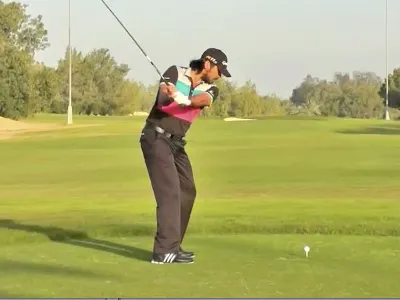
Golf Monthly Top 25 Coach Andrew Reynolds offers his Jason Day swing analysis - what can you learn from the Australian?
This is a swing to copy if you want to be a great driver of the golf ball. Simple, sound fundamentals lead to as orthodox a swing as you’ll find. There’s a lot to learn from watching the Australian, so let’s take a closer look and offer some Jason Day swing analysis.
It all starts with a fantastic base, there’s not a single angle that is wrong here. If you were creating a dream golfer, their address position would look like this. Jason’s feet, hips and shoulders are parallel to his ball-to-target line, the spine angle is spot on, the balance is even and the bend at the hips and knees means that while it’s technically sound, it’s also very athletic. In fact, I haven’t seen such a solid address position since Retief Goosen.
You might be thinking that this is all boring stuff, but if you get it right, as Jason does, you don’t have to make any compensatory movements in the swing. If you take a look at the video that accompanies this piece, you’ll notice how the club goes up and then down on almost exactly the same line. For years, coaches have spoken about a one-plane swing, which strictly speaking doesn’t exist, but he’s about as close as you can get.
The club moves away low to the ground. Some might say it’s slightly closed but, for me, its neutral. He then winds up to the top with a wide arc. There’s a big shoulder turn halfway back, and then his wrists start to hinge. At the top of the swing, from down the line, you can see the club is parallel to the ball-to-target line. A lot of people are a little bit across the line – where the club is actually pointing at the target as opposed to parallel to target, this was something that Tiger used to do.
Importantly, Jason gives himself time at the top with a smooth transition. Then he drives back down on almost the same, neutral path. His technique is so solid that there’s no whipping action to get the club back square to the ball at impact. If you take inspiration from looking at this swing, then work on the boring things such as getting all your lines right at address. If you can do that, you’ll find it hard to hit the ball a long way off line.
Subscribe to the Golf Monthly newsletter to stay up to date with all the latest tour news, equipment news, reviews, head-to-heads and buyer’s guides from our team of experienced experts.

In July 2023, Neil became just the 9th editor in Golf Monthly's 112-year history. Originally working with the best coaches in the UK to produce instruction content, he went on to become a feature writer interviewing many of the biggest names in the game including Tiger Woods, Seve Ballesteros, Rory McIlroy and Arnold Palmer.
A 5-handicap golfer, Neil is a club member who takes a keen interest in the health of the game at grassroots level. You’ll often now find him writing about club-related issues such as WHS, membership retention and how best to bridge the gap between the range and the course.